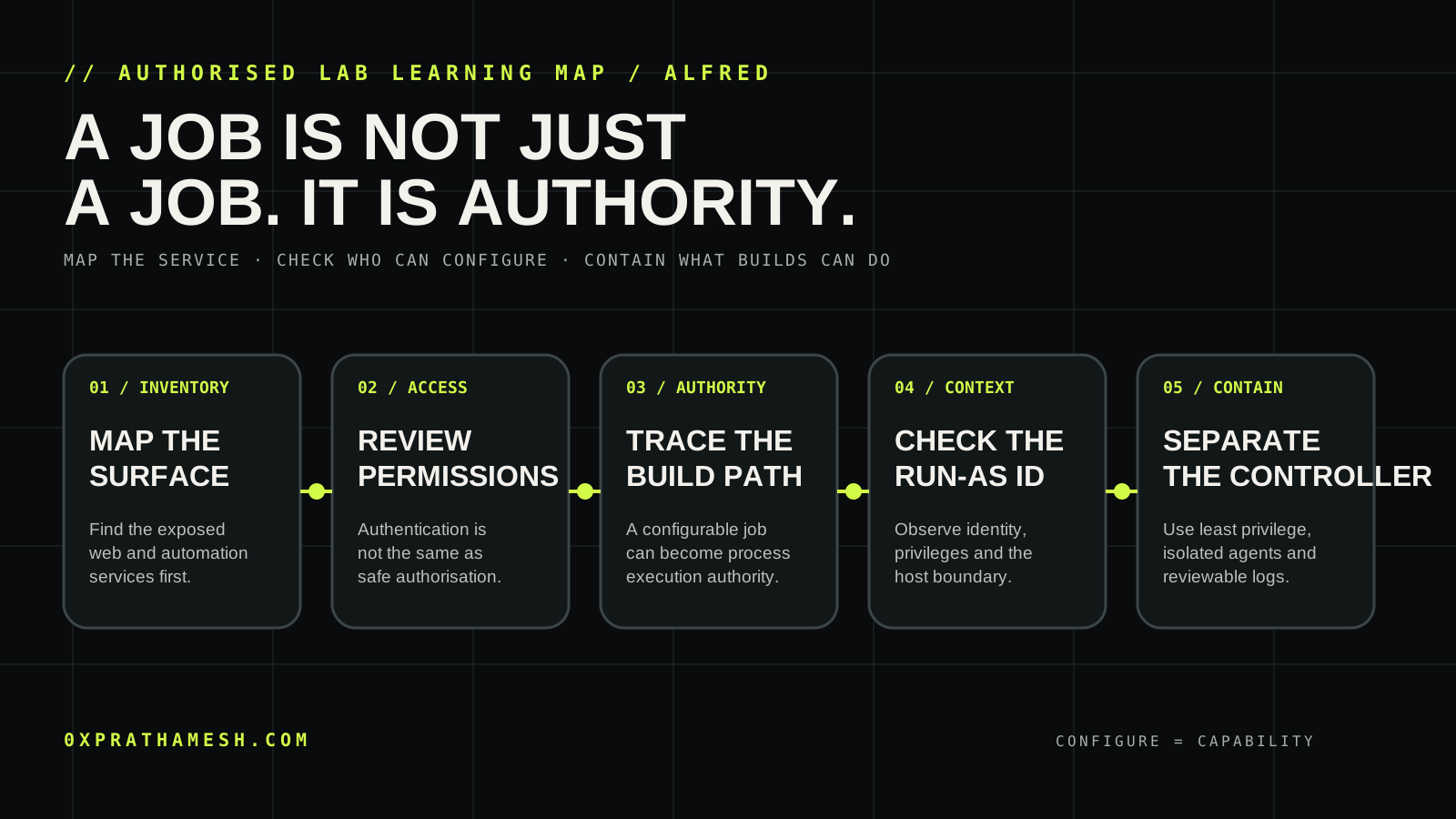
CI systems are easy to misclassify as developer tooling. In reality, they regularly hold source access, deployment rights, cloud identity, internal network reachability and the ability to start processes. Alfred is useful because it makes that invisible authority visible inside a bounded Windows lab.
The room's official premise is a misconfigured Jenkins automation server followed by a Windows privilege-escalation exercise. That is not a reason to memorise a shell recipe. It is an invitation to learn a better question: who can turn configuration into execution, and what identity does that execution receive?
01 · Scope the authority boundary
Before starting the room, write down the boundary: the deployed TryHackMe host is your only target, the goal is to understand the intended lab path, and any observation outside that host is out of scope. Replace broad “try everything” behaviour with a small evidence loop: observe a service, form a hypothesis, choose the least invasive lab-safe check, interpret the result, then update the model.
| Question | Evidence to seek | What not to assume |
|---|---|---|
| What is exposed? | A narrow TCP service inventory for the room host. | An open port does not prove a vulnerable service or usable access. |
| Who may operate Jenkins? | The room's intended authentication boundary and visible permissions. | Authentication alone does not tell you which jobs or nodes a user can control. |
| What does a build inherit? | The process identity, host location and privileges in the lab. | A high-privilege label is not a licence to generalise the result beyond the room. |
Memory aid: service, permission, identity. If you cannot connect all three, you do not yet understand the risk.
02 · Inventory before interpretation
Start with a constrained inventory of the lab machine. The point is not the tool. The point is to establish which interfaces deserve a hypothesis before you interact with them. A web service and an automation console can look like two unrelated ports until you recognise that one may be a control plane for the other.
# Lab-only service inventory. LAB_HOST is the TryHackMe machine assigned to you.
# Keep scope narrow and record only the evidence needed for the next decision.
nmap -sV -Pn --top-ports 1000 LAB_HOST
Read the result as a relationship map. A web listener can be the application itself, a management interface, or a redirect. A remote-management service can be a later confirmation point, not an opening move. Record service name, version evidence, port and one question that the service raises. Avoid password spraying, wide content discovery against unrelated hosts, and guesses based on a product banner alone.
In CI systems, a mundane-looking “configure” right can be more consequential than a striking version string because it can change what the platform asks an operating system to run.
03 · Treat job configuration as execution
The central Alfred lesson is Jenkins authority. Jenkins distinguishes authentication, which establishes a user or group, from authorisation, which assigns permissions. Its own documentation warns that configuration rights on agents can let someone make jobs run on a machine they control and reach information used by the build. The exact screen and permission model vary by installation, but the design question stays the same.
In the lab, use the intended login path and inspect the smallest relevant job configuration feature. Do not paste a downloaded payload, publish a room credential, or reuse the lab route elsewhere. Instead, reason about the capability: a job definition can specify build steps; build steps start a process; a process inherits an identity, environment and host context. That is an authority chain.
| Observed capability | Security meaning | Responsible next check |
|---|---|---|
| View a job | You can inspect declared build behaviour, subject to masking and access controls. | Identify which node runs it and whether configuration is read-only. |
| Change a build step | The user may influence process execution. | In the lab, validate the resulting process identity with a benign command. |
| Configure an agent or controller | The blast radius can include build inputs, environment variables and credentials. | Stop treating it as a convenience role; model it as high authority. |
A bounded validation in your own lab can be deliberately unexciting:
# Run only as a harmless build step in your own authorised room session.
# It identifies the context; it does not deploy a payload or alter the host.
whoami
whoami /priv
Interpret the output, do not merely collect it. The identity tells you which Windows account the automation server asked to run the process as. The privilege list explains which operating-system boundaries might be relevant to the later lab task. Keep the room's answer material private. For transfer learning, the durable observation is that CI execution is a principal with real operating-system authority.
04 · Read the Windows context before making a claim
Once the room moves beyond the automation console, do not jump from “I have a process” to “I own the system”. First establish the current user, token privileges, integrity context, filesystem constraints and whether the process is on a controller or a deliberately isolated worker. Alfred uses Windows to make the distinction visible, but the same reasoning applies to Linux runners and containers.
Think in boundaries. A build that runs as a service account may have more power than an interactive developer account. A privileged token can matter only when a specific local precondition is present. A controller may hold valuable state even when a job runs on an agent. The room lets you learn those relationships safely; it does not prove that every Jenkins instance shares them.
| Evidence | What it supports | Limit to preserve |
|---|---|---|
| Process identity | Which account the lab build currently uses. | Not every task or node uses the same account. |
| Token privileges | Which OS-controlled capabilities are exposed to that process. | A privilege name is not proof that a particular escalation path will work. |
| Job and node configuration | How the process was authorised and where it ran. | The lab configuration is synthetic and must not be transplanted to an external system. |
Common mistake: treating the privilege-escalation section as a tool-selection puzzle. It is really a context puzzle. The right question is, “which boundary is weak in this authorised machine, and which exact evidence supports that?”
05 · Contain the build plane
The defensive takeaway is simple but not small: CI/CD deserves the same threat modelling as production administration. Jenkins recommends access control, controller isolation and security-conscious build configuration. In production, that means reducing who can configure jobs, separating untrusted builds from the controller, limiting service identities, protecting credentials, and retaining audit records that let a reviewer reconstruct who changed what.
| Risk in the authority chain | Control that changes the outcome |
|---|---|
| A broad role can configure jobs or agents. | Use matrix or role-based authorisation; grant configuration only to named, reviewed roles. |
| Builds run where the controller stores secrets and orchestration state. | Use isolated, short-lived agents; do not run untrusted workloads on the built-in controller node. |
| A runner identity has standing local or cloud privilege. | Give each job only the scoped identity and short-lived credentials it needs. |
| A risky job change is invisible after the fact. | Log configuration changes, approval context, agent selection and build execution; review them as security events. |
What Alfred is really teaching
Alfred is not principally about a web panel, a Windows trick or a single machine. It teaches an architectural rule: configuration is capability when configuration can cause execution. That rule appears in Jenkins, workflow engines, cloud automation, low-code platforms and AI agents with tool permissions.
Carry the method forward: map the exposed control plane, distinguish login from authority, identify the execution principal, verify the least invasive claim in a sanctioned environment, and then design the control that breaks the chain. That produces a lesson you can reuse long after the room is complete.
Frequently asked questions
Is Jenkins a developer tool or a security control?
Both. Job configuration is execution capability: whoever can change a build job can run code as the build service. That makes the controller a control plane that needs its own isolation.
What is the safest way to review job configuration?
Treat job configuration as code that runs. Inventory who can edit jobs, which credentials jobs hold and which identity the build runs as, before drawing any conclusion about the target machine.
What does the writeup leave out?
The room's specific passwords, tokens and session details. The page teaches the authority review so you can reproduce the reasoning in your own authorised lab.
Primary references and further practice
- TryHackMe: Alfred official room
- Jenkins: Managing Security
- Jenkins: Permissions and security implications
- Jenkins: Securing Jenkins
- For another evidence-first authorised lab, read The Agent That Went Rogue: Timeline to Impact or browse all authorised write-ups.