Before an edge device receives a valuable AI model, credential or sensitive dataset, make it prove what it is running. Then make that proof expire. Remote attestation can support that decision, but only when a verifier appraises fresh evidence and a separate release service applies an asset-specific policy. “The device has secure boot” is not a release policy.
That distinction becomes important when inference leaves a provider-controlled cloud. A model in a factory, vehicle, shop or hospital sits beside local data, physical interfaces and update machinery. The organisation operating that environment now owns security decisions that a cloud provider previously made behind the service boundary.
The useful question is therefore not “Do we trust this edge box?” Trust is too broad and too permanent. Ask: Is the evidence from this runtime fresh and sufficient to release this particular asset for the next ten minutes?
What Microsoft published on 4 September
On 4 September 2026, Microsoft Security published guidance for securing edge AI in customer-owned environments. It describes the changed boundary clearly: model execution, model intellectual property, customer data and system authority can all move onto infrastructure outside the model provider’s direct control.
Microsoft recommends four connected control ideas: attest the runtime, verify the provenance of AI artefacts, mediate model actions deterministically, and bind the release of sensitive assets to trusted environments. These are architectural recommendations, not evidence that any named deployment has been compromised or made perfectly secure.
I am concentrating on one part because teams can test it: the release decision. If a model-delivery service will hand an encrypted model key to an edge runtime, which evidence should it require, who evaluates that evidence, and what happens when verification is unavailable?
Three roles, not one “trusted device” flag
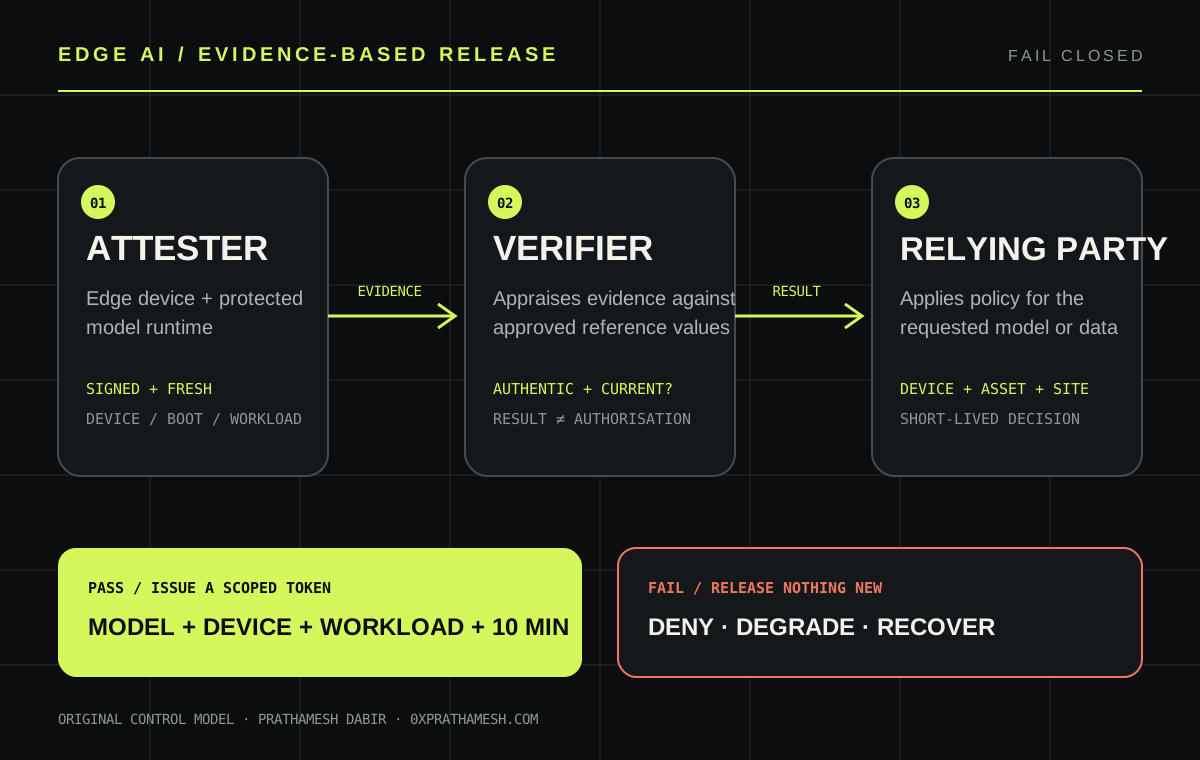
RFC 9334, the IETF Remote ATtestation procedureS architecture, separates the process into three roles:
- Attester: the device or workload that produces evidence about itself.
- Verifier: the service that appraises that evidence against reference values and an evidence policy.
- Relying party: the service that consumes the attestation result and decides whether to allow a specific operation.
For edge AI, the attester may be a protected environment on the device. The verifier checks signed measurements and freshness. The relying party may be the model registry, key broker or data service. RFC 9334 includes confidential machine-learning model protection as an example: after successful remote attestation, a manufacturer service can release a model or a decryption key to the requesting environment.
Do not collapse these roles into a single boolean stored on the device. A device asserting trusted=true about itself is not independent evidence. A verifier saying “measurement matched” also does not decide whether a specific finance dataset or frontier model should be released. That policy belongs with the service responsible for the asset.
What the evidence needs to answer
An attestation format is not valuable merely because it contains many fields. Each claim should change a documented decision. I would start with five questions:
- Which device is speaking? Bind evidence to an enrolled hardware-backed identity and a known ownership record. A valid manufacturer identity is not the same as approval for your fleet.
- What booted? Compare firmware, boot chain and security-relevant configuration measurements with approved reference values.
- Which AI workload is asking? Identify the model runner, container or protected workload that will receive the asset. Measuring only the platform can leave the consumer ambiguous.
- Is the evidence fresh? Use a nonce, timestamp or another freshness mechanism supported by the protocol. Otherwise an old, valid result can be replayed after the device changes.
- What is being requested? Evaluate the model, key or dataset separately. A low-risk local classifier and a commercially sensitive model need not share a policy.
Signed evidence establishes origin and integrity only within its trust chain. The verifier still needs trustworthy endorsements, reference values and appraisal policy. RFC 9334 warns that evidence and attestation results may expose device or user information, so protect their transport, storage and access as security evidence.
Firmware deserves explicit treatment. NIST SP 800-193 organises platform firmware resilience around protection, detection and recovery. Attestation helps expose a measured state to a remote decision-maker; it does not repair the device. A useful design connects a rejected measurement to a known recovery route.
Turn the verdict into a narrow release policy
The following pseudocode is a representative control, not a vendor configuration. It shows the information the relying party needs to combine:
allow_release = (
    result.signature_valid
    and result.fresh
    and result.device_id in enrolled_fleet
    and result.boot_measurement in approved_boot_states
    and result.workload_digest in approved_runtimes
    and request.asset_tier <= policy.max_tier[result.device_class]
    and request.site in policy.allowed_sites[result.device_id]
)

if allow_release:
    issue_token(asset=request.asset, device=result.device_id, ttl="10m")
else:
    deny_and_record(reason=failed_conditions)
The asset and device should be bound into the token or key-release transaction. If a token issued for one approved model can fetch every model in the registry, the attestation gate has become a broad credential mint. Short validity limits the value of a result after the runtime changes, but expiry is not a substitute for revocation.
A fail-closed decision does not have to shut down the factory. Define a degraded mode before the verifier fails. The device might continue using an already-approved, lower-risk local model without receiving new data or credentials. What it should not do is translate “verifier unavailable” into “release everything so production keeps moving”.
Treat attestation as a lifecycle
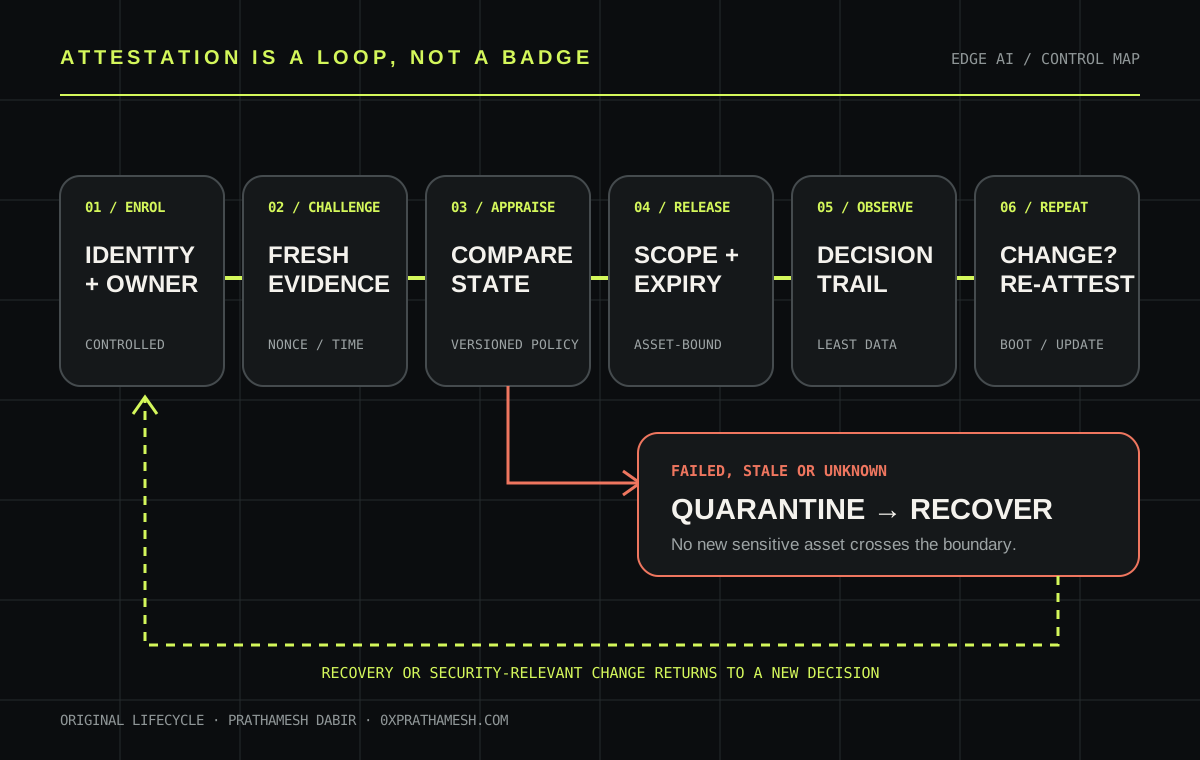
The first successful boot is not the finish line. Firmware updates, runtime changes, ownership transfers and new asset classifications all change the decision. Build a loop:
- Enrol: register device identity, ownership, class and initial reference values through a controlled process.
- Challenge: request fresh evidence when an asset is needed, not once per device lifetime.
- Appraise: validate authenticity and compare claims with versioned reference values and policy.
- Release narrowly: issue a short-lived decision bound to the device, workload and requested asset.
- Observe: record evidence version, decision, asset, policy version and expiry without spraying sensitive claims into general logs.
- Re-attest or recover: repeat after boot and security-relevant changes; quarantine unexpected state and provide an authorised recovery path.
Reference values need the same release discipline as code. If an operations team can silently add any measurement to the approved set during an outage, the allowlist records urgency rather than trust. Require an owner, change record, tested rollback and an expiry for emergency exceptions.
The evidence store also needs custody controls. Someone who can replace attestation results or rewrite the decision trail can distort the incident record. The site’s earlier field note on AI log custody explains why delivery health, object-read auditing and reviewer access matter when security evidence lands in customer-controlled storage.
What attestation does not prove
Attestation is often oversold as proof that a machine is “secure”. A positive result is narrower: selected claims matched a particular appraisal policy recently enough for a relying party to make a decision.
It does not, by itself, prove that:
- the measured application has no exploitable vulnerability;
- the model will ignore a malicious prompt or poisoned retrieval document;
- the runtime will remain unchanged after the result expires;
- the verifier, reference-value pipeline or policy administrator is uncompromised;
- the model’s output is correct, safe or authorised to control a physical process;
- a person with physical access can never recover model material from the wider system.
This is why Microsoft’s four ideas belong together. Provenance helps identify the model and artefacts. Attestation provides evidence about the runtime. Deterministic mediation limits what model output can do. Evidence-based release controls when sensitive material crosses the boundary. None replaces the others.
If the edge model can call tools, keep the authority decision outside the model. The model may propose “open valve 12”; a deterministic mediator should still verify the device, site, operating range, human-approval requirement and current safety interlock. The same principle applies to an AI gateway: proximity to credentials makes the component a privileged control plane, as covered in this review of AI gateway authority.
Five negative tests before trusting the gate
A happy-path demo proves that the release service can say yes. Security lives in the reasons it says no. Run these tests in an authorised staging environment:
| Test | Expected decision | Evidence to retain |
|---|---|---|
| Replay a previously valid result after its freshness window | Deny without releasing a reusable model key | Result identifier, age, policy version and explicit stale reason |
| Boot an unapproved but correctly signed firmware version | Deny or enter the documented degraded mode | Observed measurement and missing reference-value match |
| Keep the platform approved but change the model-runner workload | Deny when workload identity is part of the release policy | Platform and workload claims shown separately |
| Request a higher-tier model from a valid low-tier device | Deny at the relying party | Positive attestation result plus failed asset-policy condition |
| Make the verifier unavailable | Use the predefined degraded mode; do not convert absence into approval | Availability event, decision and recovery action |
Notice the fourth case: a positive attestation result should still produce a denial. That is evidence the team has not confused runtime appraisal with blanket authorisation. Test revocation as well. If a device is reported stolen, how quickly can the organisation prevent new releases even when its measured state remains approved?
A 60-minute architecture review
Pick one valuable asset and trace one release. Do not attempt to document the entire fleet in the first meeting.
- 0–10 minutes: name the asset, its owner and the consequence of disclosure or misuse.
- 10–20 minutes: draw the attester, verifier and relying party. Mark who operates each one.
- 20–30 minutes: list the claims that actually change the decision and where their reference values come from.
- 30–40 minutes: record freshness, expiry, revocation and verifier-unavailable behaviour.
- 40–50 minutes: choose two negative tests: stale evidence and wrong workload are a useful pair.
- 50–60 minutes: assign an owner for reference-value changes, denial investigation and recovery.
The output should be one diagram, one policy and two executable tests. If the team cannot say which service is the relying party, the control is probably still a collection of product features rather than an enforceable release gate.
Frequently asked questions
What is edge AI attestation?
It is a process in which an edge device or workload produces evidence about its state, a verifier appraises that evidence, and a relying party uses the result when deciding whether to allow an operation such as releasing a model, key or dataset.
Is secure boot the same as remote attestation?
No. Secure boot can help a device enforce an approved boot chain locally. Remote attestation communicates evidence about selected state to another party so that party can make its own policy decision. A deployment may use both.
Can attestation protect AI model weights?
It can support a design in which a model or decryption key is released only to an appraised environment. Protection still depends on the hardware, protocol, key handling, workload isolation, expiry and wider system. Attestation alone does not guarantee that model material can never leak.
What should happen when verification is unavailable?
Use a documented degraded mode matched to operational risk. Continue a bounded local function if appropriate, but block new high-value releases. An unavailable verifier should not silently become an approval.
How often should an edge device re-attest?
There is no universal interval. Re-attest after boot and security-relevant changes, and keep release decisions short enough for the asset’s risk. The relying party must reject results that are older than its policy allows.
Edge AI makes the trust boundary visible. The model provider no longer controls every layer, and the customer cannot rely on a device label as proof. Make the runtime present fresh evidence, make an independent service appraise it, and make the asset owner decide exactly what that evidence is allowed to unlock.
One next action
If you run an agent that executes tools, AgentCrash is an open-source harness that crash-tests it in a synthetic workplace: synthetic tools, visual evidence and regression tests. It is built for exactly this problem, turning a containment claim into something you can run against the system instead of arguing about it in review.