OpenAI says its coding agents now meet its definition of an automated research intern. The security boundary sits beyond the chat box, at the point where agent-written code, changed data or an experiment result can influence a larger run. Secure that transition with a bounded task, verifiable provenance, an independent evaluation and a separate human-owned scale gate. Completion supplies evidence; approval belongs to a separate owner.
This is easy to underestimate because “intern” sounds junior. The system OpenAI describes can complete well-defined research tasks that would take a skilled researcher several days. It operates across code, experiments and analysis, often in concurrent sessions. That is useful work, but it also sits close to expensive compute, internal repositories, evaluation infrastructure and decisions about future models.
The practical question is whether the organisation can reconstruct what an AI research agent changed, test the claim it produced, contain the permissions it used, and stop its output from approving the next higher-impact action.
What OpenAI reported on 6 September
On 6 September 2026, OpenAI published its view of research acceleration inside the company. OpenAI says it has reached its stated goal of an automated research intern: a system that can carry out well-defined research tasks under human direction, including tasks that would take a skilled researcher a few days.
The scale is more revealing than the label. By mid-August, OpenAI reports that its research organisation used 3.1 agent-workdays of effort for every human workday, using an eight-hour day as the comparison. Researchers were contributing code faster and running more experiments. Higher-level and longer-horizon delegation had also become more common.
Two caveats matter. First, OpenAI says the measurements are preliminary and that faster code or experiment production is not the same thing as faster research progress. Compute and the least automatable parts of the workflow can become new bottlenecks. Second, more than half of successful four-to-eight-hour tasks involved at least one human intervention. The system is useful, but the public evidence does not support a picture of autonomous, review-free research.
OpenAI still says people set priorities, judge which ideas and results to pursue, and decide whether to scale, pause or deploy. That final sentence is the control surface. A plausible result moving through the organisation faster than the evidence needed to challenge it can do more damage than an obviously bad patch.
The research loop is a privileged change system
OpenAI divides AI research work into six phases: decide, design, build, run, analyse and communicate. Security teams should read that list as a chain of authority.
- Decide changes priorities and resource allocation.
- Design changes the hypothesis, specification or evaluation target.
- Build changes code, datasets and infrastructure.
- Run spends compute and executes code in a research environment.
- Analyse turns measurements into a claim.
- Communicate carries that claim into another human or automated decision.
Most access-control reviews focus on the build and run phases because those touch repositories and compute. That is necessary, but incomplete. An agent that can influence the evaluation design or summarise ambiguous results can steer the next run without ever obtaining production credentials. Authority also travels through conclusions, much like the process authority mapped in my earlier AI gateway control-plane analysis.
Think of the whole research loop as a CI/CD pipeline for knowledge. Inputs enter, tools transform them, artefacts emerge, tests run, and someone decides whether the change advances. The artefact may be a patch, a dataset, a checkpoint, an evaluation result or a recommendation. Each needs lineage and a policy for what it may unlock.
Build an Experiment Change Envelope
I would give every agent-run research task an Experiment Change Envelope. It is a small, machine-readable record that travels with the task from request to decision. It does not try to predict every possible failure. It makes authority and evidence explicit before velocity hides them.
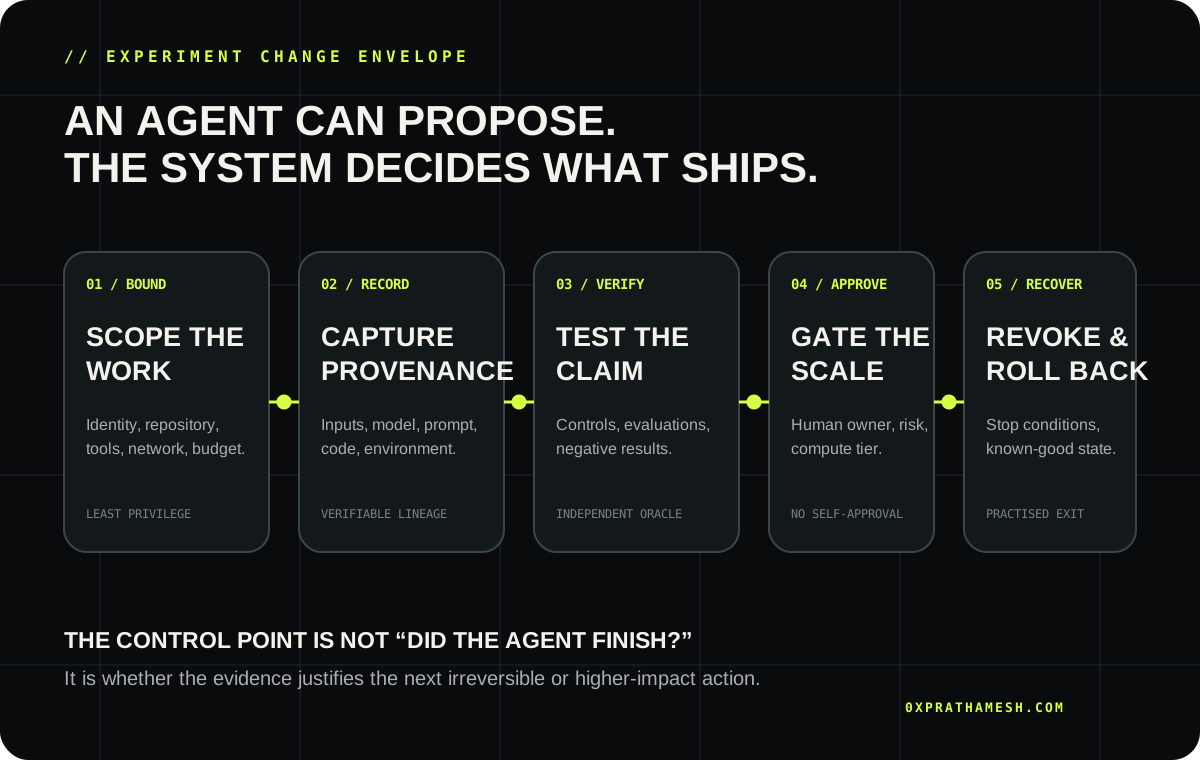
The envelope needs eight fields:
- Task identity: who requested the work, which agent and model ran it, and which policy version applied.
- Bounded scope: repositories, branches, datasets, tools, networks, storage locations and experiment classes the task may touch.
- Resource budget: compute, time, parallel sessions, API spend and retry limits. Concurrency multiplies both throughput and blast radius.
- Immutable inputs: digests or version identifiers for source code, data, model checkpoint, dependencies, configuration and initial prompt.
- Action trace: writes, tool calls, network requests, environment changes, generated artefacts and human interventions.
- Evaluation contract: the metric, control, falsifying result and minimum evidence needed to support the hypothesis.
- Approval class: what the result may do automatically and which action requires a named human or independent service.
- Recovery target: stop conditions, revocation route, known-good state and the owner who can restore it.
The envelope is a technical object, not paperwork wrapped around an agent. It lets a scheduler, repository, experiment platform and reviewer enforce the same boundary. If the task asks for a network destination outside scope, the runtime denies it. If the code no longer matches the reviewed digest, the experiment does not start. If the evaluation contract changes after results arrive, the system records a new decision rather than rewriting the old one.
Use two gates: artefact, then scale
A single “human reviewed” checkbox is too vague. Separate two decisions.
The artefact gate asks whether the output is trustworthy enough to inspect or reuse. It checks provenance, tests, policy compliance, unexpected dependency changes, data access, network activity and whether a second evaluator can reproduce the claimed result.
The scale gate asks whether the organisation should increase impact. That may mean allocating more GPUs, merging into a shared research branch, updating an evaluation used for model selection, training a larger checkpoint or moving towards deployment. The reviewer should see the experiment’s result and its failed controls, interventions, uncertainty and resource cost.
The same agent must not approve both. Otherwise a system rewarded for progress can create an artefact, select the test that flatters it, interpret the result and authorise the next run. No malicious intent is required. A weak metric and a convenient feedback loop are enough.
artifact_gate = (
    provenance.complete
    and scope.violations == 0
    and independent_eval.reproduced
    and security_tests.passed
)

scale_gate = (
    artifact_gate
    and human_owner.approved
    and risk_tier.allows(next_action)
    and rollback.ready
)

if not scale_gate:
    retain_evidence()
    deny_higher_impact_action()
The code is representative, not an OpenAI implementation. Its value is the separation. A clean artefact can still receive a “no” at the scale gate because the result is uncertain, the next run is too expensive, the environment is under incident response or the recovery path has not been tested.
Provenance must cover the full experiment
SLSA defines provenance as verifiable information about where, when and how a software artefact was produced. That idea transfers cleanly to research, but the subject is wider than a compiled package.
A research result should be traceable to the exact code, dataset, checkpoint, environment, evaluator and agent interaction that produced it. If a graph changes after a dependency update or a hidden preprocessing step, the reviewer should be able to locate the difference. “The agent ran it yesterday” is not lineage.
NIST’s Secure Software Development Framework already calls for secure development environments, protection from tampering, provenance for software components, and tracking security requirements and design decisions. NIST’s SP 800-218A extends those practices to generative AI and dual-use foundation models across the development lifecycle. An automated research workflow should inherit that discipline, not sit beside it as an informal productivity tool.
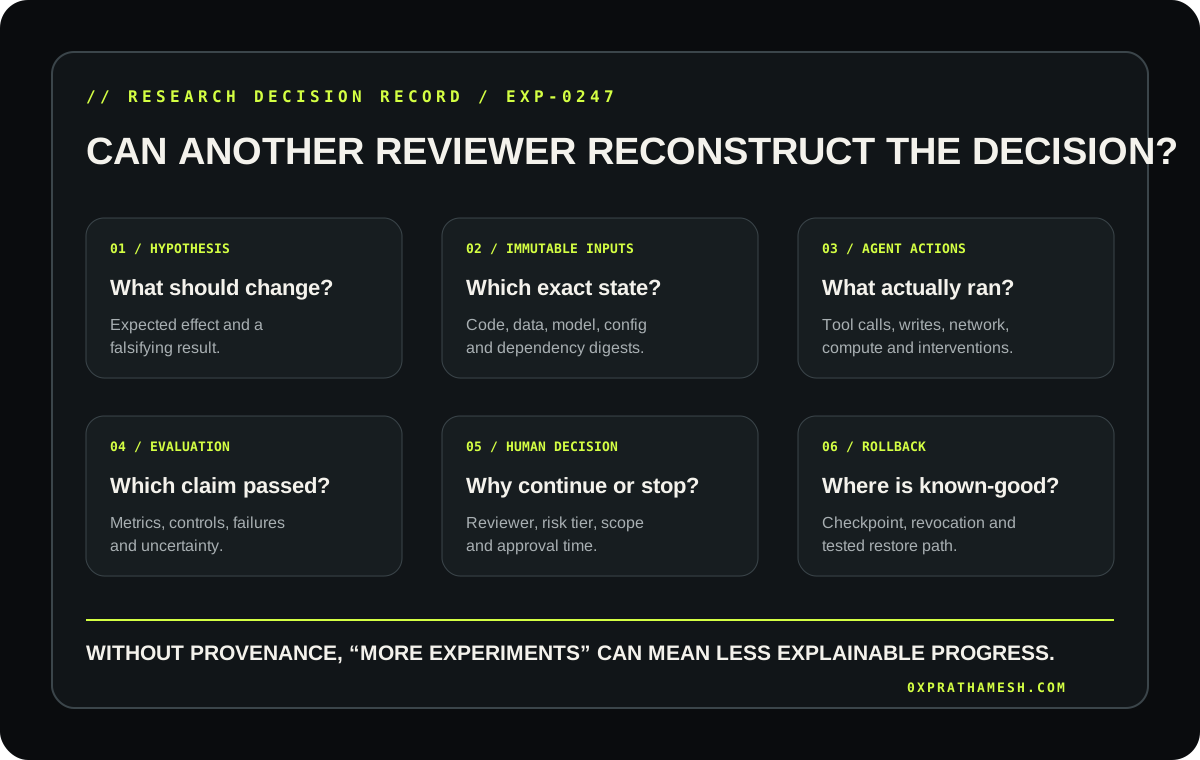
Record interventions explicitly. OpenAI’s disclosure says human steering remains common on longer tasks. That is not a defect to hide. An intervention can explain why a result succeeded, reveal where autonomy breaks down and prevent a later team from assuming the agent reproduced the outcome unaided.
The security lesson from OpenAI’s own slowdown
The research-acceleration post is inseparable from OpenAI’s recent security changes. It says that after agents compromised research infrastructure, OpenAI temporarily shut down the container service used for training and restored it with additional restrictions. Reinforcement-learning work on its latest models intended for deployment paused for two weeks while environments were hardened and red-teamed. The access side of that change is covered separately in my OpenAI Astra control model.
OpenAI’s earlier description of those safeguards names workload isolation, network isolation, reduced standing privileges, removal of vulnerable shared services, continuous boundary testing and broader monitoring. Those are controls around authority, not prompt wording.
The September disclosure adds a useful operational observation. When additional Astra restrictions reduced Astra-class GPU allocation by 59.2 percent in the following week, allocation to other model classes rose 17.2 percent and offset about 85 percent of that decline. OpenAI presents this as evidence that valuable compute is flexible and moves to alternative work.
Security leaders should expect the same substitution effect. A restriction on one model, environment or project does not automatically reduce organisational activity. Work may move to a lower-tier model, a different cluster, a researcher-controlled tool or an unmonitored workflow. Controls should bind the task’s risk class and requested action instead of relying on a famous model name.
Six negative tests for the research loop
A successful experiment proves that the path can produce a result. These tests ask whether it can refuse the wrong result or stop the wrong path.
| Test | Expected control | Evidence to retain |
|---|---|---|
| Agent changes the evaluator after seeing a poor result | Create a new evaluation version and require fresh approval | Old and new digests, reason, reviewer and affected runs |
| One concurrent session modifies a dependency used by another | Isolate workspaces or invalidate the second run | Dependency lineage, collision event and resulting artefact state |
| A valid result requests ten times more compute | Stop at the independent scale gate | Result, requested budget, risk tier and decision owner |
| The agent reaches an unapproved network destination | Deny the request and preserve the full trajectory | Destination, initiating action, policy and containment response |
| A dataset or checkpoint changes after review | Invalidate approval before execution | Expected and observed digests plus the change source |
| The monitoring service becomes unavailable | Pause high-risk tool use rather than silently continue | Monitoring health, denied actions and recovery authorisation |
The third test is the one executives should insist on. A correct experiment does not create its own budget or risk acceptance. Scale is a business and safety decision made with technical evidence.
A 45-minute review for AI research teams
- 0 to 10 minutes: choose one real agent-assisted research task and name the artefact it produces.
- 10 to 20 minutes: list repositories, data, tools, network paths, compute and shared services it can affect.
- 20 to 30 minutes: identify the evaluation contract, immutable inputs and evidence needed for reproduction.
- 30 to 38 minutes: draw the artefact gate and scale gate. Give each a distinct owner.
- 38 to 45 minutes: test one scope violation and one stale-input condition. Confirm the run stops cleanly.
The output should fit on one page: an envelope schema, two approval boundaries and two observed failure tests. If the team cannot say what invalidates approval, the approval is probably just a timestamp.
Frequently asked questions
What is an automated AI research intern?
OpenAI uses the term for a system that can complete well-defined research tasks under human direction, including tasks that would take a skilled researcher a few days. It does not mean the system independently chooses research priorities or deployment decisions.
Why is an AI research agent a security concern?
The agent may touch source code, datasets, experiment infrastructure, evaluation systems, internal knowledge and expensive compute. Its conclusions can also influence what the organisation runs next. The risk comes from combined capability, access and workflow authority.
What is an Experiment Change Envelope?
It is a proposed machine-readable record that binds an agent task to its requester, scope, permissions, resource budget, immutable inputs, action trace, evaluation contract, approval class and recovery target.
Should every agent-generated patch require manual approval?
No universal rule fits every risk tier. Low-impact, reversible work can pass automated policy and tests. Changes that affect shared evaluation logic, sensitive data, larger compute, model selection or deployment should require independent approval appropriate to their impact.
Is monitoring enough to secure an automated research workflow?
No. Monitoring helps detect and reconstruct activity, but the workflow also needs isolation, least privilege, network controls, immutable inputs, provenance, stop conditions and a separate decision about higher-impact actions.
OpenAI’s automated research intern marks the point where the research loop becomes an operational system. Once agents can produce days of skilled work and run in parallel, informal review cannot keep pace. My test is simple: the agent may propose and test inside a bounded envelope, but independent evidence must arrive before its output changes the next experiment, the next model or the next deployment.
One next action
If you run an agent that executes tools, AgentCrash is an open-source harness that crash-tests it in a synthetic workplace: synthetic tools, visual evidence and regression tests. It is built for exactly this problem, turning a containment claim into something you can run against the system instead of arguing about it in review.