A guard that enumerates values is exactly as complete as the list it was written with. PraisonAI 1.7.3 added a start up check that refuses to run AgentOS on an exposed host without an API key. The check tests membership in a set of three strings. There are more than three ways to write an exposed bind, and when the check does not fire, the authentication middleware is never registered at all. This is a local reproduction of that gap, built from scratch, with a control case that proves the harness can fail.
01 · Scope and authorisation
Everything described here runs on a server I wrote, on my own machine, on localhost and on a loopback bound port. No PraisonAI instance belonging to anybody else was contacted, scanned or probed at any point, and no hosted deployment was involved.
The subject of the analysis is published source code from the MervinPraison/PraisonAI repository and the public advisory record for CVE-2026-61426. Reading published source and reasoning about it is not testing somebody else's system.
The reproduction server is a deliberate reimplementation of the published middleware ordering, not a copy of the project's code. It exists so the consequence of the configuration gap can be observed rather than asserted. It contains no exploit, no payload and no credential belonging to any real service.
If you want to confirm this for yourself, do it the same way. Run it locally, bound to a port you control, against a server you wrote.
02 · What the advisory says
CVE-2026-61426, tracked as GHSA-6wjp-v33h-5cvq, is scored 8.6 and covers the praisonai-ts npm package below version 1.7.3. The summary states that AgentOS defaults to a network exposed no authentication mode, which allows unauthenticated agent invocation and disclosure of agent instructions.
It was published on the 8th of October 2026 as one of sixteen advisories in a single wave. The fix is version 1.7.3.
That is the claim I wanted to examine, because the interesting question is not whether the reported issue was fixed. It is whether the fix closed the class of problem or only the reported instance of it.
03 · Reading the patched configuration
The relevant source lives in src/praisonai-ts/src/os/config.ts and src/praisonai-ts/src/os/agentos.ts. I read the current state of both on the project's main branch, which includes the fix.
Three things are worth stating precisely, because the whole analysis depends on them.
First, the default bind host is now 127.0.0.1. This is a real improvement and it closes the default case. An operator who changes nothing is no longer exposed.
Second, the default corsOrigins value remains ['*']. Permissive cross origin policy was not the reported issue, so it was not changed. It widens the consequence of any binding mistake that does occur.
Third, a new start up guard refuses to run when the server is bound to an exposed host without an API key. It throws with a message stating that AgentOS requires an apiKey, or the PRAISONAI_AGENTOS_API_KEY environment variable, when binding to a network exposed host.
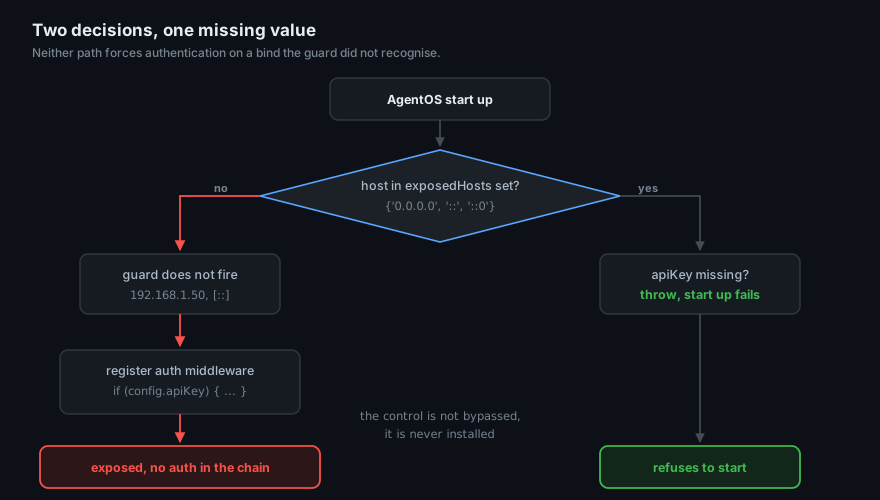
The guard is implemented as a set membership test. The set contains three strings: 0.0.0.0, :: and ::0. If the configured host is in that set and no key is configured, start up fails.
04 · The question the guard does not ask
A set membership test asks whether a value is one of these specific values. It does not ask whether a value has a property.
The property that matters here is reachability from outside the host. That property is not a list. It is satisfied by the any address in several spellings, and it is satisfied by every specific address on a routable interface.
So the guard answers the question "is this one of the three ways I know to write the any address" when the question that matters is "will this bind be reachable from off box".
Those two questions agree on the reported input and disagree on several others. That disagreement is the gap, and it is visible in the shape of the code before any test is run.
05 · Porting the guard to confirm the reading
Reading code and believing you understand it are different things, so I ported the configuration merge and the guard logic into a standalone script and ran it against a spread of host values. No network involved, just the decision logic.
The result confirms the reading exactly.
A bind to 0.0.0.0 with no key throws, as designed. That is the reported case and the fix handles it.
A bind to 192.168.1.50 with no key starts and serves. A specific LAN address is not in the set, so the guard does not fire, and the server is reachable by every host on that network segment.
A bind to 10.0.0.7 with no key behaves the same way, for the same reason.
A bind to [::], the bracketed IPv6 any address, starts and serves. It is the same address as ::, written the way it appears in most configuration files and URLs, and it is not the string in the set.
A bind to ::ffff:0.0.0.0, the IPv4 mapped form of the any address, starts and serves for the same reason.
Five exposed binds, one of them caught.
06 · The second decision, and why it matters more
If the guard were the only control, the gap would be a hardening weakness. It is not the only control, and the second one makes it a direct authentication bypass.
In agentos.ts, the authentication middleware is registered inside a conditional that tests whether an API key is configured. If no key is set, the middleware is not added to the chain.
Put the two together and the failure mode becomes clear. The guard is supposed to make a missing key fatal on exposed binds. The middleware treats a missing key as a reason to skip authentication entirely. Both decisions read the same missing value, and when the guard fails to recognise the bind, nothing forces authentication.
The result is not a weak credential or a bypassable check. There is no check in the chain at all.
This is the failure mode I find most consistently in agent frameworks, and it is the one tests are worst at catching. A test that exercises authentication configures authentication first, so the path where the control was never installed is the path no test visits.
07 · Building the reproduction server
To observe the consequence rather than infer it, I wrote a small HTTP server that mirrors the published middleware ordering. It uses Node's built in http module and has no dependencies, which matters because a reproduction with a dependency tree is a reproduction you cannot trust to be minimal.
The server does four things. It applies cross origin headers from the configured corsOrigins value, defaulting to the permissive wildcard. It registers a bearer token check only when an API key is configured, matching the conditional in the real code. It serves an agent listing endpoint that returns agent definitions including their instruction text. It serves a chat endpoint that invokes the named agent.
The agent in the listing is fictional. It is called finance-bot, its instructions reference an environment variable name, and none of it corresponds to a real deployment or a real secret. It exists to demonstrate what instruction disclosure looks like when the listing endpoint is unauthenticated, which is the disclosure the advisory describes.
An earlier attempt used Express and failed because the install was interrupted and the module was never present. Rewriting on the standard library removed the problem and made the artefact smaller, which was the better outcome anyway.
08 · The three case matrix
A single test that returns data proves nothing, because a harness that returns data unconditionally would produce the same output. So the reproduction runs three cases, and the third exists purely to try to make the harness fail.
Case A binds to [::] with no API key configured. This is the gap: an exposed bind the guard does not recognise.
Case B binds to 127.0.0.1 with no API key configured. This is the safe default, included so the comparison is not only between exposed and authenticated.
Case C binds to 127.0.0.1 with a throwaway API key configured. This is the control. The key is a dummy string generated for the test, used by nothing, valid for nothing, and never sent anywhere.
Each case is probed with the same three requests: an unauthenticated agent listing, an unauthenticated chat invocation, and a request carrying a hostile Origin header.
09 · What the probes returned
In case A, the unauthenticated agent listing returned HTTP 200 with the agent definitions in the body, including the instruction text. No credential was presented and none was required.
The unauthenticated chat invocation also returned HTTP 200. The request body carried a prompt that a legitimate operator would never send, and the server processed it as a normal invocation, because there was no mechanism present to decide otherwise.
The request carrying an unrelated Origin header received permissive access control headers in response, including credential allowance. A browser on any page would be permitted to read these responses.
In case C, the control, all three probes returned HTTP 401. The agent listing, the chat invocation and the Origin probe were all rejected.
That contrast is the entire value of the exercise. The same server code, with the same probes, returns data in one configuration and refuses in another. The 200 responses in case A are therefore a property of the configuration, not an artefact of a permissive test harness.
10 · The check that generalises
The specific finding here matters to anyone running AgentOS, but the reusable part is the question that found it.
When you read a security patch, find the guard and ask whether it tests a property or enumerates values. If it enumerates, the fix is bounded by the author's imagination at the moment of writing, and attackers get to iterate afterwards.
Then ask a second question, which is whether the control can be skipped rather than defeated. Trace the registration path. If the control is installed conditionally, find out what happens when the condition is false, because that is the configuration most deployments will reach by accident.
A guard that tests a property would have closed this entire class. Resolving the configured host and asking whether the resulting address is routable off box answers the real question, and it does not care how the address was spelled.
11 · If you run this
Upgrade first. Version 1.7.3 for praisonai-ts, and 4.6.78 for the Python package, which covers the other fifteen advisories in the same wave.
Then do the parts the upgrade does not do. Set an API key explicitly rather than relying on the guard to notice you need one, because the guard is the thing with the gap. Set the bind host explicitly rather than inheriting a default. Set corsOrigins to the origins you actually use, since the wildcard default was not changed by the fix.
If you run AgentOS anywhere other than loopback, put an authenticating reverse proxy in front of it and do not rely on the framework's own check as the only gate. The analysis above is precisely a demonstration that this particular gate has holes in it.
Finally, verify rather than assume. Bind it the way you intend to run it, send an unauthenticated request to the agent listing endpoint, and look at the status code. If it returns 200, you have the configuration described here.
12 · What I would do differently
The first version of this reproduction was built against the wrong advisory. I had been working from a GHSA identifier that I believed covered the AgentOS authentication issue, and when I re-verified the record before writing, it turned out to describe a different problem entirely, arbitrary file write through AICoder tool calls at CVSS 9.9.
The reproduction itself was unaffected, because it had been built from reading the AgentOS source rather than from the advisory text. But the write up would have attributed it to the wrong CVE, and that is the kind of error that destroys trust in everything else in the document.
The fix was to re-fetch every advisory record and verify each identifier against its own summary before any prose was written. That step costs a few minutes and it caught a mistake that would have been embarrassing in public.
The general lesson: verify identifiers at the point of writing, not at the point of research. Research notes drift, and the moment of writing is the last point where an error is cheap.
13 · The reproduction matrix
Three configurations of the same server, probed identically. Case C is the control.
| Case | Bind host | API key | Agent listing | Chat invoke | Origin probe |
|---|---|---|---|---|---|
| A, the gap | [::] | none | 200, instructions returned | 200, invoked | permissive headers |
| B, safe default | 127.0.0.1 | none | 200, loopback only | 200, loopback only | permissive headers |
| C, control | 127.0.0.1 | set | 401 | 401 | 401 |
The control returning 401 across all three probes is what makes the case A results meaningful.
14 · Host values tested against the guard
0.0.0.0with no key: guard fires, start up throws. Correct.192.168.1.50with no key: guard silent, server starts and serves the LAN.10.0.0.7with no key: guard silent, server starts and serves.[::]with no key: guard silent, same address as::in bracket notation.::ffff:0.0.0.0with no key: guard silent, IPv4 mapped any address.
One of five exposed binds is recognised by a guard whose entire job is recognising exposed binds.
Frequently asked questions
What is CVE-2026-61426?
CVE-2026-61426, tracked as GHSA-6wjp-v33h-5cvq, is a vulnerability in the PraisonAI AgentOS server scored 8.6. AgentOS defaulted to a network exposed mode with no authentication, which allowed unauthenticated agent invocation and disclosure of agent instructions. It is fixed in version 1.7.3 of the praisonai-ts npm package.
Does upgrading to 1.7.3 fully fix the problem?
It fixes the default case, because the default bind host moved to 127.0.0.1. It does not cover every exposed bind. The start up guard tests the configured host against a set of three literal strings, so a bind to a specific LAN address, to the bracketed IPv6 any address, or to the IPv4 mapped any address does not trigger it. Operators should set an API key explicitly rather than relying on the guard.
Why does a missing API key remove authentication entirely?
The authentication middleware is registered inside a conditional that tests whether an API key is configured. When no key is set, the middleware is never added to the request chain, so there is no authentication step to bypass. The start up guard is meant to make this fatal on exposed binds, but it only recognises three host spellings.
How do you test this safely?
Write your own server that mirrors the published middleware ordering, bind it to a port you control on your own machine, and probe it with ordinary HTTP requests. Never point a reproduction at a deployment you do not own. Always include a control case, such as the same server with authentication configured, so you can prove the harness is capable of returning a rejection.
What is the difference between a guard that enumerates and one that tests a property?
An enumerating guard holds a list of known bad values and is exactly as complete as that list. A property test asks whether a value has a dangerous characteristic, which covers values nobody thought of. In this case, resolving the configured host and asking whether the resulting address is routable off box would close the whole class, regardless of how the address was written.
Primary references and further practice
- GHSA-6wjp-v33h-5cvq / CVE-2026-61426, AgentOS network exposed no auth mode
- GHSA-9mp3-24cc-77mg / CVE-2026-61445, AICoder arbitrary file write via LLM tool calls, CVSS 9.9
- GHSA-hc5v-gxvj-58wh / CVE-2026-61427, MCP HTTP stream transport unauthenticated by default
- PraisonAI source repository, src/praisonai-ts/src/os/
- AgentCrash, open source harness for testing agent deployments
One next action
If you run agents in production, take the check in section 10 to your own stack this week. Find one security control, trace whether it is registered unconditionally or behind a configuration test, and write down what happens when that test is false. If you want the question automated instead, AgentCrash is the open source harness I build for exactly this.