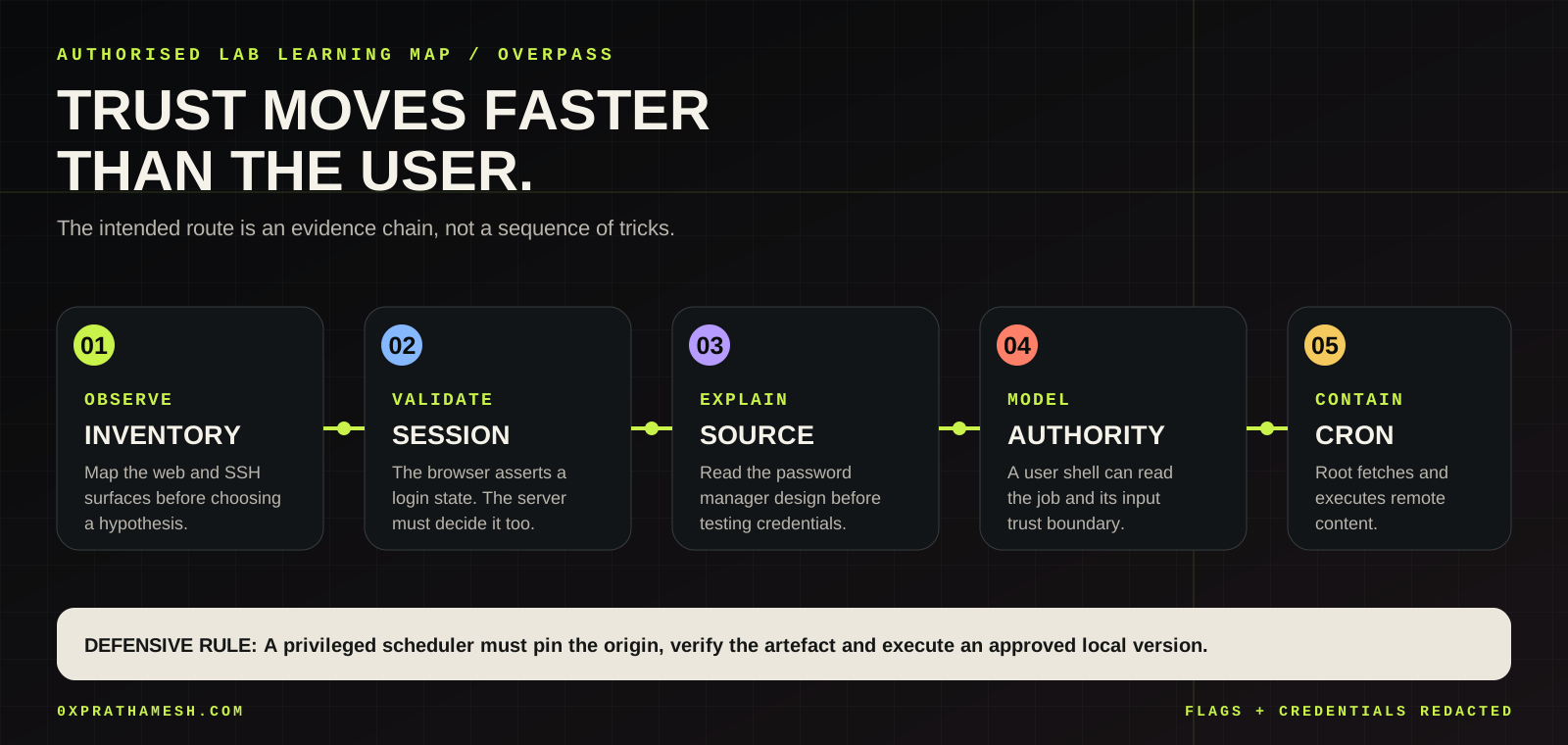
Overpass is a compact lesson in misplaced trust. The web application lets the browser decide that a user is authenticated, the downloadable password-manager source turns a secret into reversible data, and a privileged cron job fetches a script using a name that a lower-privileged account can redirect.
This is an original learning companion for the official room. Flags, recovered passwords, target IPs and proof strings remain private. The working loop is simple: observe a boundary, form one hypothesis, choose the least invasive lab-only check, interpret the result, then update the model.
01 · The attack model: map who gets to decide
The room exposes web and SSH services. Web access first leads to an administration area whose client-side code controls a session marker. That marker reveals a source bundle, which explains how the password manager handles a local credential. An SSH session then exposes a root-owned updater. The final question is not whether cron can run a script. It is who can influence the hostname and response that root executes.
HINT 01 AUTHENTICATION
Opening an admin page proves very little. Find out whether the server checks a real session on every protected request.
HINT 02 SOURCE
Downloadable source is a design document. Read how a value is generated before attempting to use it.
HINT 03 SCHEDULERS
A privileged job that pulls remote content has three trust decisions: name resolution, transport integrity and artefact verification.
02 · Build a small service inventory
Start with the private address assigned to the running room. A small scan gives you the reachable services and enough version context to choose a web or SSH branch. Save the output because later observations should be connected to facts, not remembered loosely.
export LAB_IP="<tryhackme-assigned-ip>"
mkdir -p nmap
nmap -sC -sV -Pn -oA nmap/overpass "$LAB_IP"
-sV asks for service versions, -sC runs
Nmap's default scripts, and -oA records evidence in
three formats. The room presents HTTP and SSH. That is a
normal-looking pair, so the next move is simple web discovery rather
than guessing users or passwords.
# Representative result, not an observed scan
22/tcp open  ssh
80/tcp open  http
03 · Session trust: the browser cannot grant access
Use the site's visible routes, links and a constrained content discovery pass to find the administration surface and downloadable material. Limit the wordlist and status codes so the action remains evidence gathering, not traffic generation.
ffuf -u "http://$LAB_IP/FUZZ" -w /usr/share/seclists/Discovery/Web-Content/common.txt -fc 404 -t 20 -of json -o content-discovery.jsonOn the room's admin route, inspect JavaScript as part of the application's security design. The important question is whether the server authenticates a protected endpoint or whether the front end merely checks whether a cookie has a value. OWASP's authentication testing guidance calls out fixed client-controlled parameters as an authentication-bypass risk.
curl -s "http://$LAB_IP/admin/" -o admin.html
grep -Eo 'src="[^"]+\.js' admin.html
curl -s "http://$LAB_IP/<admin-script>" -o admin.js
grep -nEi 'cookie|session|login|redirect' admin.js
In this authorised room, the client code exposes a session assertion that can be altered in a lab browser or intercepting proxy to reach admin content. The lesson is narrower than cookie manipulation: protected endpoints must validate an unexpired server-side session and authorise the requested action. A front-end redirect is presentation logic, not access control.
Store session meaning and access rights on the server, use an opaque session ID, and authorise every protected request. Secure, HttpOnly and SameSite cookie attributes help browser handling, but they do not replace server-side validation.
04 · Source review: distinguish encoded from protected
The admin content points to an Overpass source bundle. Download it locally and read the code before trying any credential. A source review answers two useful questions: where the application stores data, and whether an apparent secret is encrypted, hashed or merely encoded.
mkdir -p overpass-source
unzip <lab-source-archive> -d overpass-source
rg -n -i 'password|hash|encrypt|decrypt|rot|ssh|config' overpass-source
The room's password-manager implementation uses a reversible transformation for the stored value. Reversible obfuscation can hide text from a casual glance; it does not establish a security boundary. Decode only the lab value locally, verify that the result is structurally plausible, and keep it out of notes, screenshots and shell history. The actual password is intentionally not published here.
Before using a recovered lab credential, ask what claim it tests. Here, it tests the SSH user boundary indicated by the source and room artefacts. It is not permission to re-use the value across services or outside the room.
Passwords should be salted and password-hashed with a modern adaptive function. Keep source archives free of secrets, use a secret manager for configuration, and treat client-distributed code as public.
05 · User access is evidence, not the finish line
Use the redacted, room-only result to authenticate once to the user account identified by the lab. Then establish the local authority model before looking for escalation: identity, groups, scheduled jobs, service files, writable locations and the provenance of anything a privileged process consumes.
ssh <lab-user>@"$LAB_IP"
id
cat /etc/crontab
ls -l /etc/hosts
The significant evidence is a root-owned cron entry that retrieves a
build script through a hostname and pipes the response to a shell.
The Linux crontab(5) documentation explains that system
crontabs name the user context before the command. Here that context
is root, so every boundary in the retrieval chain is privileged.
06 · Root cron update: when name resolution becomes code control
A cron job that executes remotely fetched content combines three decisions: which host a name resolves to, whether the connection identifies the intended server, and whether the retrieved artefact is approved. In Overpass, a lower-privileged account can influence the local host-resolution entry used by the root job. A writable configuration file therefore becomes part of a code-execution path.
# Read-only evidence first. Do not publish the room's exact line or live address.
grep -nE 'curl|wget|bash|sh' /etc/crontab
getent hosts <lab-update-hostname>
ls -l /etc/hosts
For a controlled lab proof, use the smallest harmless artefact possible. Host an approved test script that writes the effective identity to a temporary proof file, redirect only the room's update hostname according to the room's boundary, then wait for one scheduled interval. Do not use a remote-shell payload and do not use this technique outside the fictional machine.
# Lab-only proof shape. Use your assigned room address and a harmless artefact.
mkdir -p lab-update/downloads/src
printf '#!/bin/sh\nid > /tmp/overpass-lab-proof\n' > lab-update/downloads/src/buildscript.sh
python3 -m http.server 80 --directory lab-update
# Restore the room mapping after the one scheduled proof.
This verifies the trust failure without publishing a privileged-shell recipe. The durable defensive fix is to stop executing remote content directly. Root should resolve a pinned endpoint over authenticated transport, download to a controlled directory, verify a signature or digest against a trusted key, and execute an approved local artefact. If any check fails, the job should stop.
Remove the pipe-to-shell pattern. Pin the update origin, use HTTPS with certificate validation, verify a signed release, restrict the configuration-file ACL and run the updater with the least privilege possible.
07 · Decision log: recognise the stop conditions
The admin page is visible but actions fail
That can mean the browser gate changed while the server still enforces authorisation. Treat it as a working control, not a reason to keep modifying cookies. Compare a protected request with and without the session state, then stop if the server rejects both.
The source value does not decode cleanly
Do not guess transforms indefinitely. Verify the exact source version and whether the value is a hash, an encoded sample or a fixture. Source tells you the function to reason about; it does not justify spraying SSH.
SSH works but the cron path is absent
Return to the evidence. Inspect the system crontab and relevant service configuration, then check whether the intended hostname resolves locally. A successful user shell is not proof that every published detail still applies to the current room image.
The update does not reach the harmless test server
Restore the lab mapping and read the job configuration again. Confirm the scheduled interval, path and network reachability. Do not broaden the redirect, modify unrelated names, or leave the environment changed after testing.
When a claim is not supported, write down the mismatch and return to the last proven boundary. This prevents a lab run from becoming trial-and-error activity.
08 · Findings, fixes and detection opportunities
| Finding | Why it matters | Fix | Detection |
|---|---|---|---|
| Client-side authentication assertion | The browser claims a session without proving it to the server. | Use server-side sessions and authorise every protected request. | Alert on admin requests with invalid, missing or malformed sessions. |
| Reversible credential storage in distributed source | Obfuscation turns a local secret into recoverable text. | Use adaptive password hashing and keep secrets out of source archives. | Scan releases for secrets and monitor unusual source-bundle access. |
| Writable host-resolution configuration | A lower-privileged account can alter where a trusted name points. | Restrict ACLs and manage resolution centrally. | Alert on hosts-file writes and unexpected local name overrides. |
| Root cron pipes remote content to a shell | Name, network and content trust failures become root execution. | Pin origin, verify signed artefacts and execute approved local files. | Alert on cron-launched curl or wget piped to shells, especially as root. |
MITRE ATT&CK maps scheduled-task abuse to T1053.003: Cron. A privileged scheduler that creates a network connection, receives unverified data, then starts a shell is a stronger signal than an isolated curl command.
09 · What transfers beyond this room
- Every protected route needs a server-side decision. A client redirect, hidden button or cookie value is never access control.
- Source code explains attack surface. Look for how secrets are generated, stored and recovered before testing a credential.
- Privilege is a supply-chain property. A root job inherits the risk of every DNS answer, URL, certificate, file and interpreter it trusts.
- Prefer harmless proofs. Demonstrate identity or controlled file creation in a lab before reaching for an interactive payload.
- Repair chains as chains. Hardening SSH does not fix a root updater that accepts unverified network content.
References and source notes
Frequently asked questions
What does this room really teach?
It teaches who gets to decide: the browser does not grant access, encoded content is not protected content, and a mutable name-resolution boundary can turn a root cron job into code control.
Why is session trust called client-side?
Login state stored or asserted by the browser can be tampered with or replayed. Server-side verification is the boundary that determines what a session is actually worth.
What is the defensive priority?
Verify session state server-side, keep private keys protected, and audit cron jobs that fetch or run remote content without pinning the source.