Lame is one of Hack The Box's earliest machines and is now retired. Its value is not the time-to-root. It is the discipline it demands from a deceptively simple service list. An old version string is a lead. A vendor advisory tells you the affected condition. A configuration decision explains why the lead could become a real boundary failure.
That distinction transfers straight into security work. Asset discovery, vulnerability management and incident response all fail when a scanner's product name is promoted to a finding without evidence of exposure, reachability and impact.
Scope and learning goal
The public machine page describes Lame as an easy Linux machine and identifies it as retired. That establishes the setting for this exercise: use only the IP allocated inside your own Hack The Box session. The learning goal is to move through a small evidence loop without mistaking an exploit title for a conclusion.
| Stage | Question | Evidence required |
|---|---|---|
| Observe | Which network services are exposed? | Protocol, port and service identity from the authorised lab host. |
| Hypothesise | Does a published advisory plausibly apply? | Version range plus the advisory's documented precondition. |
| Validate | Can the lab's service reach the risky configuration path? | A bounded platform-provided validation, performed only in the isolated lab. |
| Repair | What stopped being a safe boundary? | A concrete control owner, configuration change and monitoring signal. |
Memory aid: product, version, precondition, boundary, proof. Missing one? Keep the item as a hypothesis.
Phase 1: inventory before theory
Start narrowly. A full port scan might be a legitimate lab exercise, but it is not the first proof of a Samba issue. Record the services the lab exposes and retain the raw output in your private notes. The host address below is intentionally supplied as an environment variable rather than copied from a live platform.
# Use only the address allocated to your own retired-machine session.
export LAB_HOST="<authorised-lab-host>"
nmap -sV -sC --reason "$LAB_HOST"

# Ask SMB for a service-level view without attempting authentication.
smbclient -L "//$LAB_HOST" -N
Why these commands: version detection makes a claim about what a service says it is. The SMB listing checks whether the protocol accepts an anonymous conversation and reveals its own share metadata. Neither command proves that a historical vulnerability is exposed. They simply give you a defensible starting state.
Write an evidence register while you work. For every service, capture the protocol, discovered version, authentication behaviour, exposed role and the question it creates. Lame intentionally presents more than one tempting old service. The useful habit is to rank leads by evidence quality, not by how dramatic a search result looks.
| Observation | What it supports | What it does not support |
|---|---|---|
| An SMB daemon identifies a historical release family | An advisory lookup is warranted. | That the host has the required configuration. |
| Anonymous share listing responds | The server accepts this limited request. | That file access, code execution or privilege is available. |
| A public exploit module exists | Someone documented a possible mechanism. | That the module is appropriate, safe or successful here. |
Phase 2: turn a version into an evidence-backed hypothesis
The relevant primary record is Samba's advisory for CVE-2007-2447. It documents a remote command-injection issue in Samba 3.0.0 through 3.0.25rc3. Crucially, it does not say that every server with that banner is equally exposed. The advisory identifies the root cause: unfiltered input reaches /bin/sh through external scripts defined in smb.conf.
That one paragraph gives you a much better research model than an exploit database title:
- Identity: Does the authorised lab's service plausibly belong to the documented affected range?
- Precondition: Is an external script hook, such as a username mapping script, actually relevant to the reachable path?
- Boundary: Can a remote protocol input become an argument passed to a shell?
- Impact: What authority would the invoked script have, and what defensive control would stop it?
The specific precondition matters because Samba says the username-map-script option was not enabled by default. A version string plus a CVE identifier is therefore not enough to write “vulnerable”. In a real assessment, you would require configuration access or a safe, authorised validation that demonstrates the behaviour. In this retired lab, you have the platform's isolated setting to learn the same decision process without turning it into a test against somebody else's system.
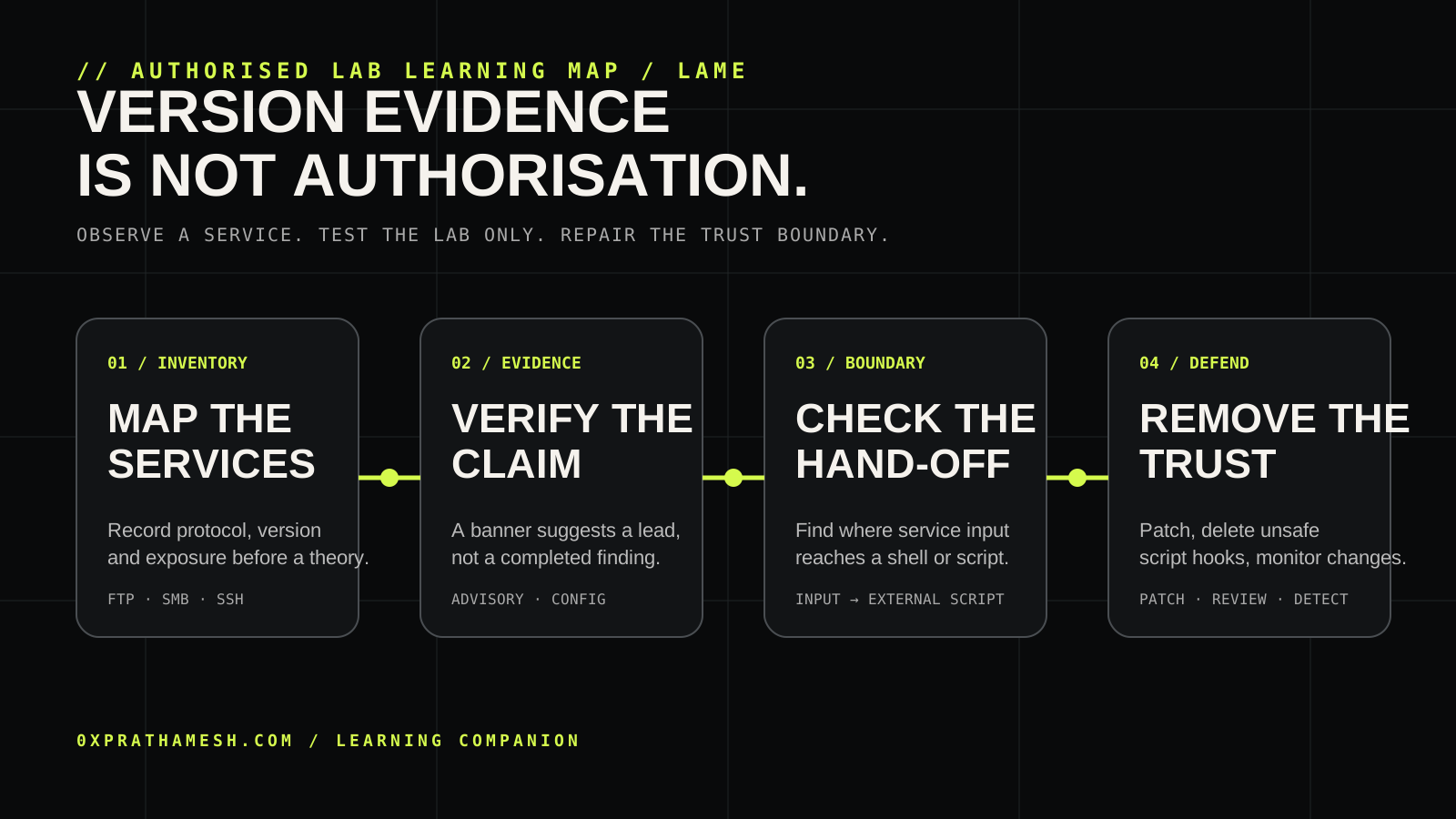
Phase 3: map the actual trust boundary
The advisory's important phrase is “external scripts defined in smb.conf”. This is a classic service-to-shell hand-off. The network daemon receives an identity or management request. Configuration chooses a helper program. The helper launches through a shell. If the inputs are not constrained before that hand-off, the service boundary has silently inherited shell semantics.
| Component | Intended responsibility | Failure to look for | Defensive owner |
|---|---|---|---|
| SMB listener | Accept and authenticate file-sharing requests. | Accepting a parameter that is later reinterpreted. | Service administrator. |
| Samba configuration | Map a service operation to an approved action. | Calling external scripts unnecessarily or ambiguously. | Configuration management owner. |
| Shell or helper | Perform a narrowly defined local task. | Parsing user-controlled data as an instruction. | System owner and code maintainer. |
| Operating-system identity | Limit what the helper can change. | Running a helper with broad, unreviewed privilege. | Platform or Linux administrator. |
Ask a practical question at every arrow: could the previous component hand arbitrary text to the next one? If the answer is yes, test whether the text is escaped, allow-listed, treated as data, or passed through a shell. This approach works for web applications, CI runners, backup wrappers and cloud automation just as well as SMB.
Phase 4: validate only inside the retired lab
At this point, the correct next action is deliberately bounded: use the retired machine's learning context to validate the documented condition, then stop once the identity and permission boundary are understood. Do not paste a reusable command-injection string into a public write-up and do not recycle it outside the platform.
A platform-safe workflow looks like this:
- Keep the target limited to your allocated retired-machine IP and the current session.
- Use the relevant platform hint or your own locally installed training tooling to test the advisory condition.
- After a successful lab-only validation, record only the role and privilege context, not a flag, address, token, shell transcript or credential.
- Immediately switch from “how did it run?” to “why was this process allowed to run with that authority?”
This is not a gap in the write-up. It is the learning boundary. A reader who understands the documented configuration precondition and the service-to-shell transition can recognise and fix the same class of defect. Replaying a payload teaches far less and creates a snippet that does not belong outside a lab.
Common wrong turn: selecting the first public module that names a service version. Modules encode assumptions. They may fail, take a different route, or create noisy effects that obscure the evidence you need. The primary advisory is a stronger guide because it describes the affected versions, the configuration condition and the root cause.
Detection and repair
Samba's own advisory offers two immediate actions: patch to a fixed release and remove defined external script invocations where they are not required. The durable repair is broader: no untrusted protocol field should reach a shell. If a helper must exist, pass structured arguments without a shell, allow-list their values, minimise the helper's account and log the invocation.
| Control | Why it breaks the chain | Useful verification |
|---|---|---|
| Patch or retire unsupported Samba | Removes the known vulnerable implementation. | Inventory installed package versions and track end-of-life status. |
| Remove unused script hooks | Deletes the service-to-shell route entirely. | Review managed smb.conf for external command directives. |
| Avoid shell mediation | Stops a data field becoming a command-language fragment. | Inspect process execution telemetry and helper source or wrapper design. |
| Least privilege for helpers | Limits impact if a separate flaw reaches the helper. | Review service accounts, file ownership and privileged execution paths. |
| Alert on configuration drift | Finds a dangerous hook before a remote user reaches it. | Baseline configuration files and alert on new external command directives. |
What Lame is really teaching
The machine is not a lesson in memorising an old CVE. It is a lesson in refusing to stop at the product version. Vulnerabilities become incidents through a path: an exposed listener, a reachable feature, an unsafe configuration, an interpreter boundary and excessive authority. Break any one of those links and the story changes.
When you meet a surprising banner in another authorised lab, use the same five questions: what was observed, what condition does the primary source require, where is the interpretation boundary, which identity performs the action, and what evidence proves the final effect? That is a method worth carrying beyond Lame.
Frequently asked questions
Why start with a service inventory?
A version string is only a hypothesis. An inventory tells you which services, ports and configurations exist, so the CVE check is grounded in evidence instead of guesswork.
Is an old version proof of exploitation?
No. A version suggests a precondition, but the actual trust boundary is the service configuration and the interaction that crosses it. Validate only inside the retired lab.
What is the durable control?
Patch the vulnerable component, remove the unnecessary service and log authentication anomalies. Then verify the running version after the change, not just the package list.
Primary references and further practice
- Hack The Box: Lame retired machine page
- Samba: CVE-2007-2447 security announcement
- NIST National Vulnerability Database: CVE-2007-2447
- Samba documentation
- For another evidence-led learning companion, read Basic Pentesting: Evidence to Access or browse all authorised write-ups.