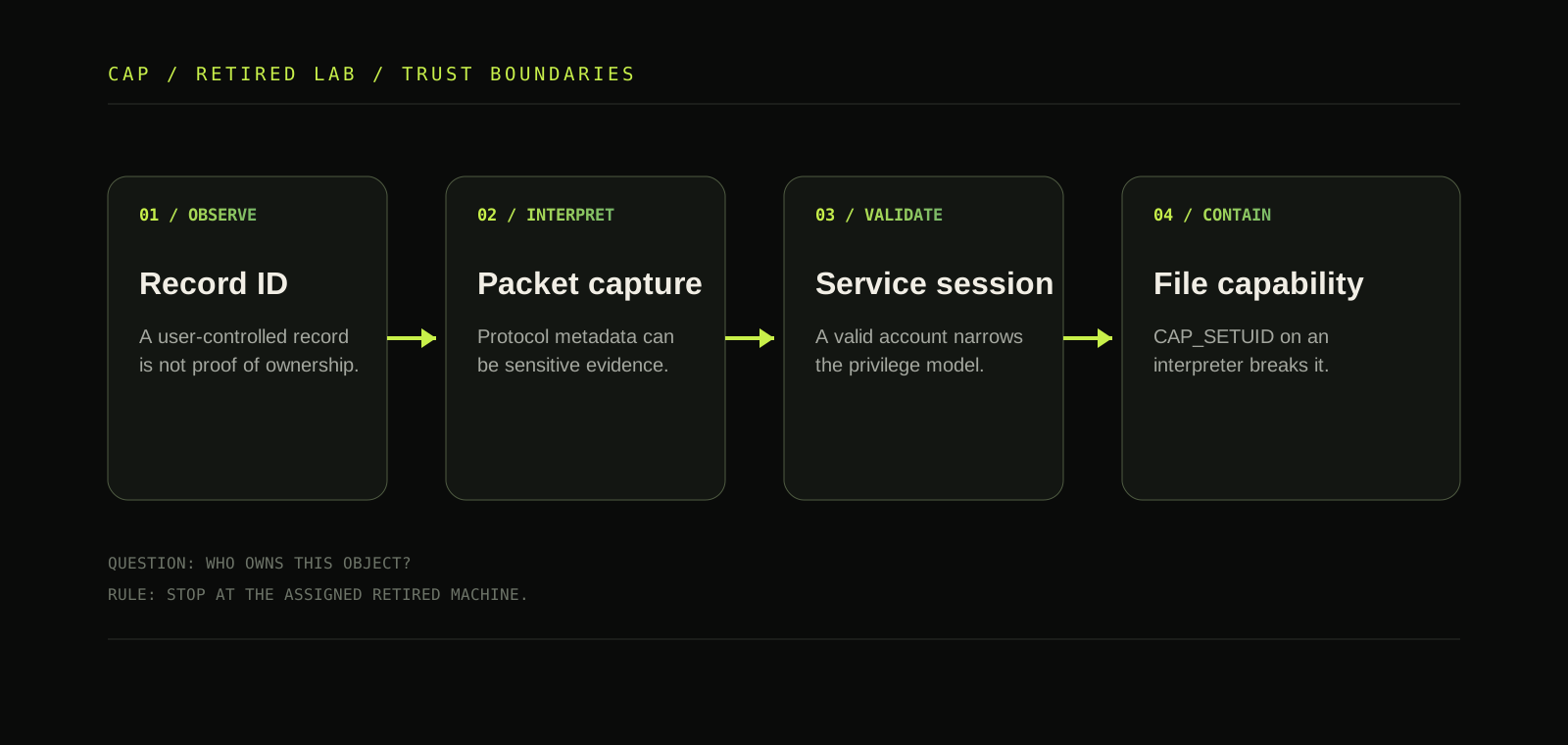
Cap is a useful beginner machine because the compromise is less about a clever payload than an engineering habit: an identifier is not an authorisation decision. The retired lab moves from a capture record reachable through an insecure direct object reference to protocol evidence, a valid service session, and a file capability that grants more power than its owner intended.
The official synopsis confirms that broad path. This companion stays on the transferable questions: what the evidence establishes, what it does not establish, and where to stop. Results below are representative, not claimed observations from a live instance.
01 · Scope, prerequisites, and objectives
Difficulty: Easy. Prerequisites: basic HTTP requests, an idea of TCP services, and comfort reading a packet capture. Keep the retired instance address, every lab credential, and any flags private. The platform boundary is part of the exercise: do not reuse a request, credential, or scan against another host.
By the end, you should be able to explain why predictable object identifiers need a server-side ownership check; triage a packet capture without spraying credentials; distinguish a valid account from a privilege boundary; and assess file capabilities as carefully as SUID and sudo rules.
02 · The route is a chain of misplaced trust
HTB describes Cap as an HTTP administration service that performs network captures. The defensive model is more interesting than the route: the web layer accepts a record reference without proving the requester owns that record; a capture can preserve a clear-text protocol exchange; an account valid for one service is treated as evidence to inspect a small local privilege model; and an interpreter has CAP_SETUID, allowing arbitrary UID changes.
There is no vendor CVE to attach to this chain. The record-access flaw maps cleanly to CWE-639, authorisation bypass through a user-controlled key. The privilege problem is better described as improper privilege management, CWE-269, than as a made-up software vulnerability.
HINT 01 OBJECTS
If a dashboard gives you a capture identifier, ask what proves you are allowed to read that object. A sequential-looking value is a clue for an ownership test, not permission to enumerate.
HINT 02 PCAP
Use protocol hierarchy and a display filter before searching raw bytes. You want evidence of the service that carried an authentication conversation, not every string in the file.
HINT 03 LOCAL MODEL
After a valid service login, inspect identity and explicit elevation controls. File capabilities sit beside sudo and SUID in that review.
03 · Build a service inventory, then read the application
Start with the host assigned by the retired HTB environment. -Pn skips host discovery when the lab route does not answer discovery probes; -sV asks open services for version information; -sC runs Nmap's default scripts; and -oA saves normal, XML, and grepable output for later review. Version detection is evidence, not proof that a version is exploitable.
export LAB_HOST="<assigned-retired-htb-host>"
nmap -Pn -sV -sC --reason -oA cap "$LAB_HOST"
Representative output:
PORT   STATE SERVICE  REASON
21/tcp open  ftp      syn-ack
22/tcp open  ssh      syn-ack
80/tcp open  http     syn-ack

Service Info: OS: Unix
The right next action is to use the HTTP service as a person would. Read the dashboard, note how it names a capture, and compare the application's controls with its server-side response. Avoid content fuzzing, password guessing, or scanning a neighbouring address. Nothing in a retired lab extends authorisation beyond that one instance.
04 · A record number is not proof of ownership
The observation is simple: an administrative page exposes a capture record. The hypothesis is narrower: perhaps the record reference is accepted without a session-bound ownership check. Test that claim with the smallest authorised change, one adjacent lab record reference, and stop after you can decide whether the server checks ownership.
# Conceptual request against the assigned lab only
GET /<capture-resource>/<adjacent-record-id> HTTP/1.1
Host: <assigned-retired-htb-host>
A successful response for another user's record confirms an authorisation failure. It does not justify walking the whole identifier space. The evidence needed for a report is the mismatch between the authenticated user and the object owner, a timestamp, the affected route class, and a redacted result. Do not save or publish traffic that is not needed to prove the issue.
Use an indirect identifier where appropriate, but do not mistake opacity for access control. Every object lookup must enforce the requester, tenant, role, and purpose server-side. Add regression tests for cross-user and cross-tenant record access.
05 · Treat a packet capture as sensitive evidence
The recovered capture is an artefact, not a trophy. Open it offline and first identify its protocol mix. Wireshark documents packet-capture formats and display filters; RFC 959 defines FTP, a protocol whose control channel does not provide modern transport encryption by itself.
# Read a local, redacted copy of the authorised lab capture
capinfos <authorised-capture>.pcap
tshark -r <authorised-capture>.pcap -Y ftp -T fields \
  -e frame.number -e ip.src -e ip.dst -e ftp.request.command
Representative output:
frame  source        destination   command
  42   [redacted]    [redacted]    USER
  44   [redacted]    [redacted]    PASS

Credential values intentionally omitted.
The interpretive step matters. A visible FTP control exchange supports a hypothesis that credentials were exposed in transit. It does not tell you whether those values work elsewhere. If the next sanctioned service rejects them, record the mismatch once and return to the evidence. Do not try variations, reuse values on other targets, or disclose them.
Troubleshooting: if the file has no FTP traffic, inspect protocol hierarchy and the time range before assuming you missed a password. If the capture will not parse, verify you downloaded an actual capture response rather than an HTML error page. If a filter returns no packets, remove the filter and confirm the file has frames. These checks preserve the evidence instead of creating noise.
06 · A valid service session is a new boundary
In the retired lab, the official synopsis says the capture contains plain-text credentials that lead to foothold. Keep the value private and validate it once against the service the lab indicates. The goal is a precise local model, not an interactive collection exercise.
ssh <lab-user>@"$LAB_HOST"
id
pwd
sudo -l
Representative output:
uid=1000(<lab-user>) gid=1000(<lab-user>) groups=1000(<lab-user>)
User <lab-user> may run the following commands:
    (none)
A denied sudo route is useful information. It says privilege has not been delegated through sudo. Move to explicit checks that explain the host's privilege surface, then stop as soon as a high-confidence control failure appears.
07 · Linux capabilities can make an interpreter privileged
Traditional Unix permissions make root a broad exception. Linux capabilities split parts of that authority into smaller privileges. The Linux manual states that CAP_SETUID permits arbitrary manipulation of process UIDs. A file capability attached to a general-purpose interpreter is dangerous because the interpreter can run code that uses its effective privilege.
getcap -r /usr/bin /usr/local/bin 2>/dev/null
# Inspect only binaries reported by getcap before attempting any action.
Representative output:
/usr/bin/<interpreter> = cap_setuid+epgetcap displays capabilities attached to files. In the lab, confirm the binary's capability and understand the interpreter's UID-changing API before taking the smallest possible authorised proof. A generic illustration is an interpreter process requesting UID 0, followed by a harmless identity check. Do that only inside the assigned Cap instance and do not publish the exact command, a shell transcript, or the final proof string.
File capabilities should be granted to narrowly scoped, audited binaries only. Remove CAP_SETUID from general-purpose runtimes, review package and configuration management that restored it, and alert on capability changes.
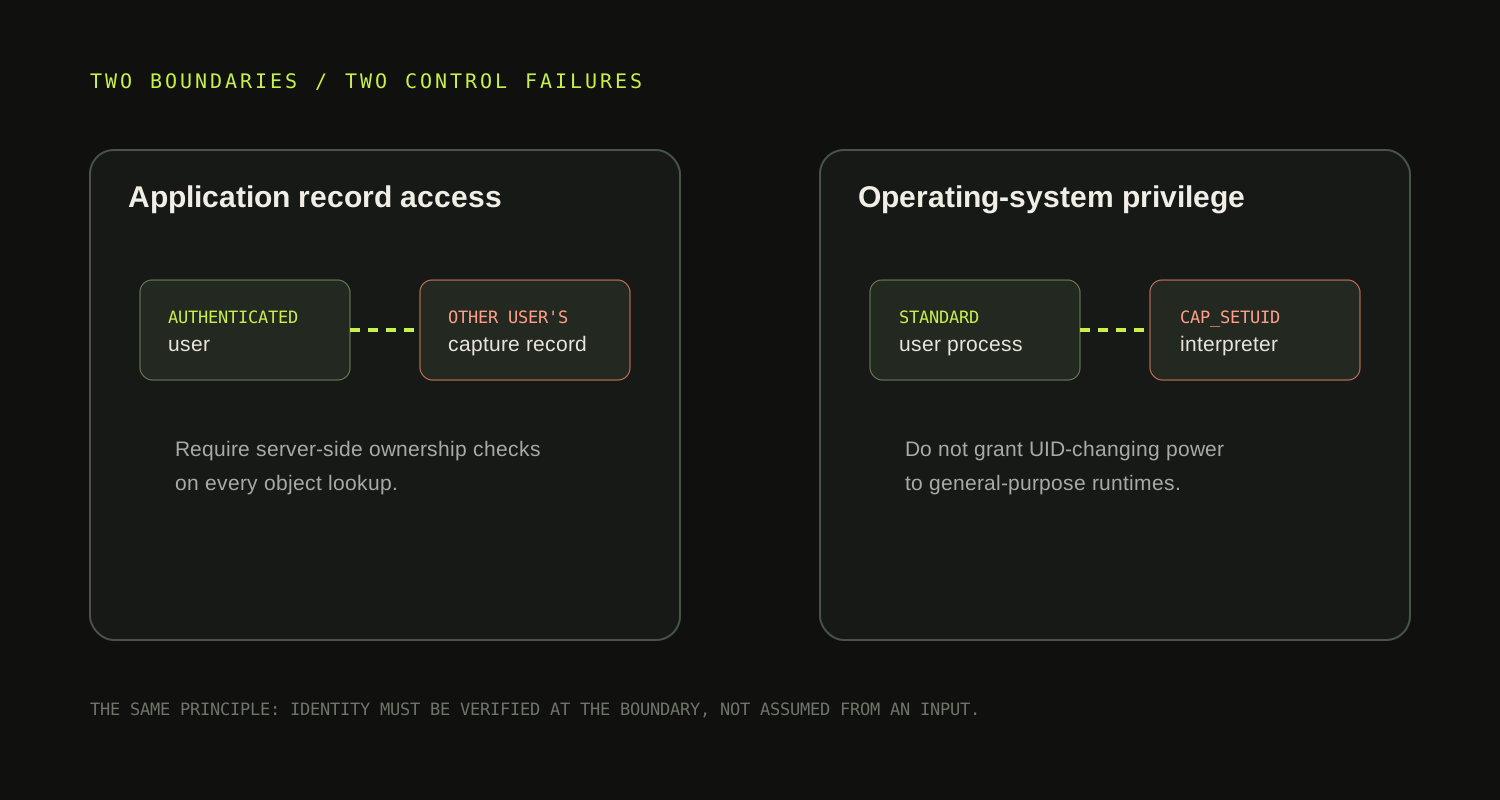
Memory aid: object, packet, principal, privilege. At each noun, ask who owns it, who can read it, what it reveals, and which authority it carries. That small sequence finds both failures in this machine.
08 · Fixes, logs, and a technique map
| Finding | Map | Control | Detection |
|---|---|---|---|
| User-controlled capture reference bypasses ownership | CWE-639 | Authorise every record lookup against the current principal and tenant. | Log actor ID, object ID, owner ID, route, decision, and a correlation ID; alert on cross-owner attempts. |
| Capture retains clear-text authentication material | RFC 959 risk context | Replace FTP with a protected transfer design; minimise capture retention and access. | Alert on FTP control traffic and unexpected capture exports; restrict capture-store reads. |
| Interpreter carries CAP_SETUID | CWE-269; ATT&CK T1548 | Remove the capability and use a narrowly scoped service design. | Audit security.capability xattr changes and executions of capability-bearing binaries. |
A practical detection path joins web authorisation logs with capture-store audit logs, then checks host telemetry. On Linux, audit rules or an endpoint agent should record execution of a capability-bearing binary and changes to extended attributes. For the web application, a 200 response matters less than whether the actor was entitled to that object.
The relevant ATT&CK relationship is limited: valid credentials in the lab may resemble T1078 Valid Accounts, while an overpowered local binary belongs near T1548 Abuse Elevation Control Mechanism. These labels organise defender thinking; they do not replace an evidence-backed finding.
09 · Practice checklist
- For each user-controlled identifier, prove the server verifies object ownership.
- For each capture or export, identify the protocol and retention risk before examining payloads.
- For each recovered account, validate it once in its assigned context and then model local rights.
- For each Linux host, review sudo, SUID, scheduled tasks, writable paths, and file capabilities together.
- For each proof, keep the smallest redacted record that establishes impact and stop there.
References and source notes
Frequently asked questions
What is an IDOR and where does it appear here?
An insecure direct object reference appears when a record number is used as proof of ownership. The route in this lab treats a predictable identifier as authorisation.
Why is a packet capture treated as sensitive?
PCAP files can contain credentials, session tokens and internal identifiers. In the lab, capturing and reading one is a privacy lesson, not just a technique.
How do Linux capabilities change the final boundary?
A service session is not host authority. An interpreter running with an unnecessary capability can cross from service to host control.