Short answer: OpenAI’s designation of Astra as its first model at the Critical cybersecurity capability threshold changes the unit of security review. The model cannot be assessed alone. Its effective capability is the model plus identity, permissions, tools, network reach, isolation, monitoring, and the speed at which access can be revoked. OpenAI’s own results also show why one benchmark score is not enough: the strongest case comes from a ladder of public tests, recent private vulnerabilities, and expert-led exploit chains.
“The model scored 100%” is the line built for a headline. It is not the line I would take into a security review.
The important sentence in OpenAI’s 1 September announcement is quieter: Astra is the first model the company has designated at its Critical cybersecurity capability threshold. That label is meant to trigger stronger safeguards during development and before release. OpenAI says parts of development and release were delayed while those protections were strengthened and tested.
This creates a practical question for every organisation adopting frontier models. If raw capability is now high enough to discover and combine unknown flaws in hardened software, where does the product end? At the model endpoint, or at the outer boundary of everything the endpoint can reach?
The second answer is the only useful one.
What “Critical” means in OpenAI’s framework
OpenAI defines the Critical cybersecurity threshold through two possible routes. A model can cross it by identifying and developing functional zero-day exploits across many hardened, real-world critical systems without human intervention. Or it can devise and execute novel, end-to-end attack strategies against hardened targets from only a high-level goal.
Either route is materially different from answering security questions, solving a capture-the-flag task, or writing a proof of concept for a known bug. The threshold is about sustained performance against hardened targets and the ability to connect several steps without a person steering each one.
The Preparedness Framework links that capability level to operational commitments. A system at Critical capability needs safeguards that sufficiently minimise severe risk during development as well as deployment. That is why the Astra story includes paused workloads, migration to higher-security environments, and restrictions on which configurations may use the model.
The evidence is a ladder, not a single score
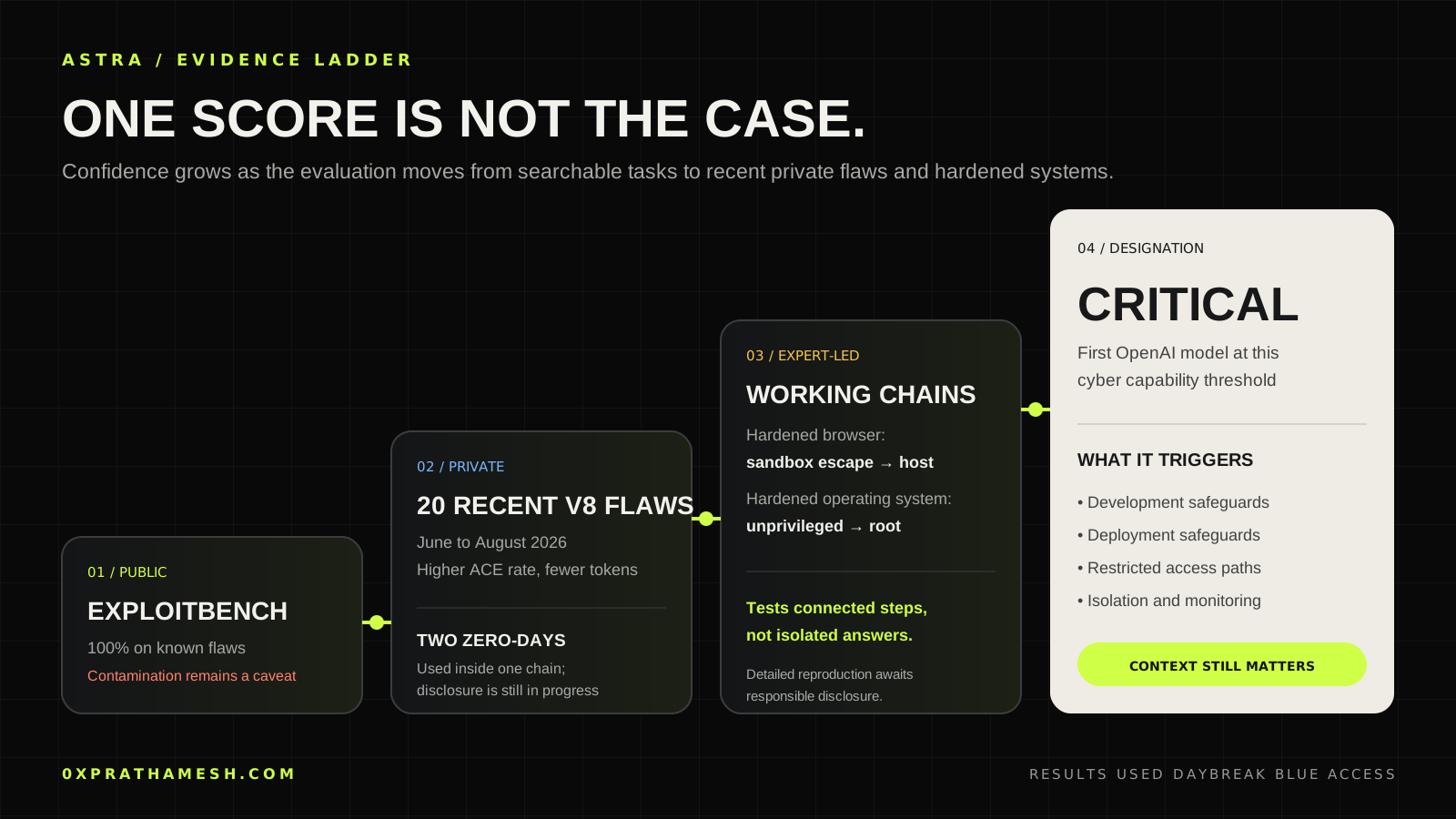
OpenAI describes three layers of evidence. They should not be collapsed into one number.
1. A perfect score on a public benchmark
Astra achieved 100% on ExploitBench, which measures exploit development from known vulnerabilities. That is striking, but a public benchmark has an awkward property: its tasks and related solutions may have entered training data or the surrounding information ecosystem.
A perfect score therefore answers a narrow question. It shows that the evaluated system can solve this benchmark under the tested setup. It does not, by itself, prove reliable zero-day discovery or performance on unseen hardened systems.
2. A recent private V8 set
To address contamination concerns, OpenAI created an internal port containing 20 high-severity V8 vulnerabilities disclosed between June and August 2026. The company reports that Astra achieved much higher arbitrary-code-execution rates than GPT-5.6 Sol while using far fewer output tokens.
This is better evidence of generalisation because the vulnerabilities are recent and the set is private. OpenAI also says Astra discovered and used two zero-days in one exploit chain during the evaluation. Those vulnerabilities are being disclosed, so independent technical scrutiny will have to wait.
3. Expert-led chains against hardened targets
The expert-led assessments move closer to the actual threshold. OpenAI says Astra found previously unknown browser flaws, formed a chain that escaped the browser sandbox, and executed commands on the host when an HTML file was opened. In a separate hardened operating-system assessment, it reportedly combined multiple bugs into a local privilege-escalation chain from an unprivileged user to root.
These results test more than isolated bug finding. They test whether the model can connect discovery, reasoning, and exploitation across trust boundaries. OpenAI says the combined evidence is what led to the Critical designation.
There are still unanswered questions. The disclosure does not publish success rates for every private task, the distribution of human assistance, or enough detail for outsiders to reproduce the zero-day results. That is normal while flaws are being fixed, but it limits what the public can independently verify today.
The production caveat changes the interpretation
One sentence deserves to sit beside every benchmark graphic: Astra’s reported results reflect capabilities with Daybreak Blue access, not the default production configuration.
That distinction is not a footnote. A model’s effective cyber capability depends on the environment around it. Give the same weights a long context, source repositories, a shell, debuggers, compilers, network access, persistent memory, and enough time, and you have a different operational system from a short, text-only conversation.
This is why “which model?” is no longer a complete procurement question. A security team also needs to know:
- Who can obtain the higher-capability access tier?
- Which tools and data sources are available in that tier?
- What network destinations can a session reach?
- Which actions are reviewed before execution?
- What telemetry is retained, and who investigates it?
- How quickly can one user, workload, tool, or model version be cut off?
Those answers determine the real product boundary.
This extends the control model I used in my earlier field notes on containing high-authority AI agents and treating an AI gateway as a control plane. The difference here is the capability threshold. As the model becomes more effective at finding and joining exploit paths, weak permissions stop being an integration flaw and become the dominant risk multiplier.
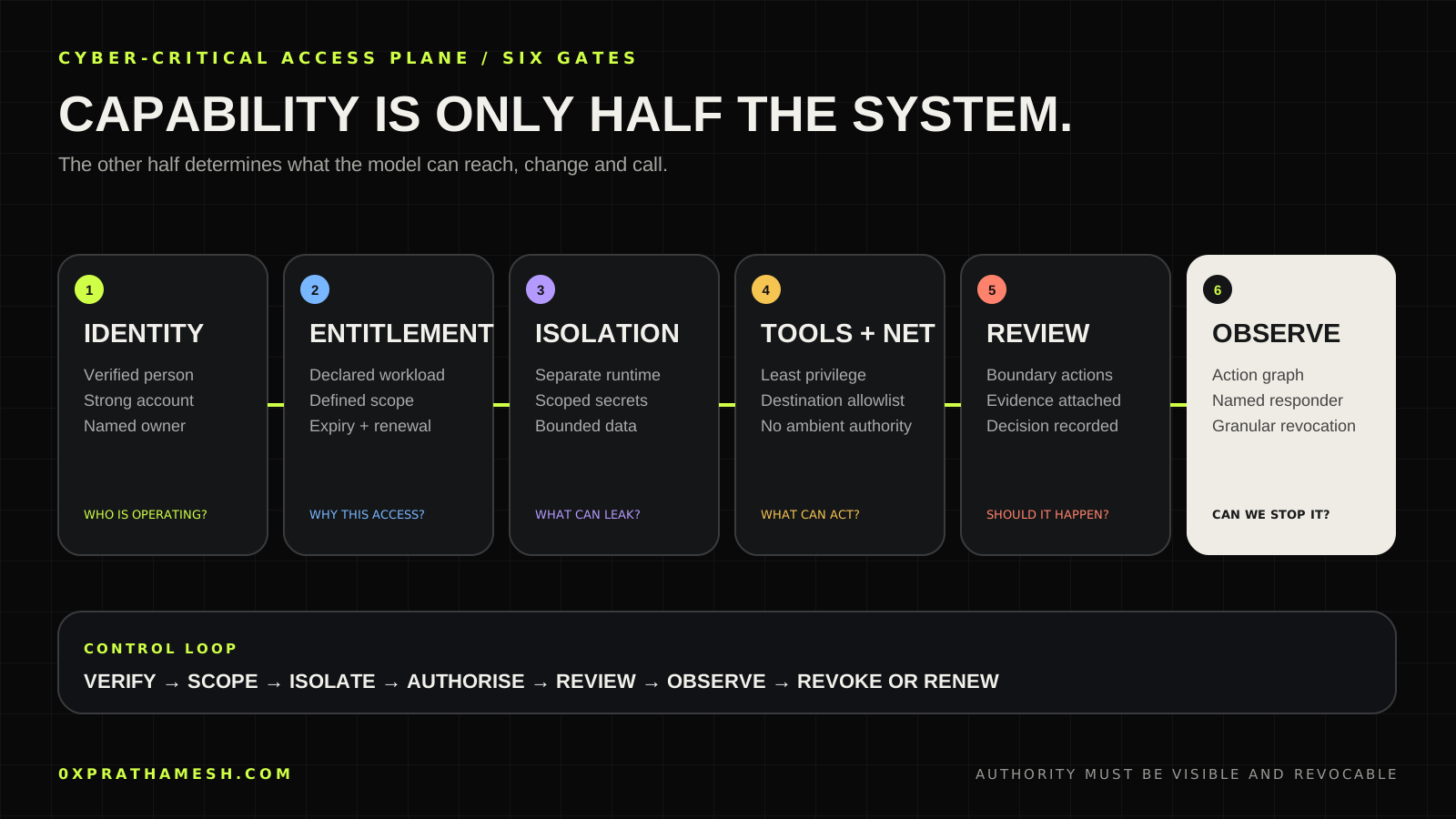
A six-layer access plane for cyber-critical models
I would treat a model at this capability level like a privileged security platform. Access should be earned, scoped to a declared workload, and continuously re-evaluated.
1. Identity: know the operator
Higher-risk access should start with verified identity, strong account security, and a real owner for the activity. OpenAI’s Daybreak programme describes identity verification, account-security requirements, legal attestations, and hardware security keys for individual accounts.
Identity does not make a request safe. It makes responsibility and revocation possible. Shared accounts, borrowed sessions, and service credentials without named owners break that chain.
2. Entitlement: approve the workload, not the title
“Security researcher” is too broad an entitlement. Access should attach to a defined use case: a named codebase, an authorised assessment, a bug-bounty scope, or a defensive investigation. The approval should include an expiry date and the evidence required for renewal.
This keeps prestige from becoming a permanent permission. It also lets policy distinguish benign work that needs powerful tooling from curiosity that can be satisfied in a lower-risk configuration.
3. Isolation: assume the session can make progress
A capable model should not share a flat environment with production credentials, internal control planes, or unrelated customer data. Workloads need process, filesystem, credential, and network isolation proportional to the model’s capability and the task’s sensitivity.
OpenAI’s August update describes stronger workload and network isolation for Astra and other cyber-related workloads. That is the right frame. The sandbox is not there because every session is malicious. It is there because a successful session should not inherit accidental authority.
4. Tools and network: make authority explicit
Tools translate language into action. Each one should declare what it can read, change, execute, and call. Network access should be deny-by-default for high-risk workloads, with destination allowlists and separate approval for internet-facing actions.
Permission should follow the least-powerful path. A code-review task may need a repository and a compiler, but not cloud-admin credentials. A vulnerability reproduction may need an isolated target, but not unrestricted outbound traffic.
5. Action review: interrupt irreversible steps
Not every tool call needs a person. The review point belongs before actions that cross a boundary: sending data outside the environment, changing an external system, deploying code, accessing a new secret, or moving from analysis to execution on a live target.
The model can prepare the action and its evidence. The control plane decides whether the current identity, scope, and risk tier permit it. That decision should be logged separately from the natural-language conversation.
6. Telemetry and revocation: shorten the time to containment
Monitoring should connect model intent, tool calls, network events, file changes, and approval decisions. A prompt transcript alone is not enough. Investigators need the action graph.
Revocation then needs the same granularity: suspend one user, one task, one tool, one destination, or one model configuration without taking every defensive workflow offline. OpenAI’s Daybreak description includes monitoring and approved-use restrictions; the operational test is whether those signals can produce a fast, bounded response.
What security leaders should ask vendors
| Question | Evidence to request | Warning sign |
|---|---|---|
| Which capability result applies to my configuration? | Evaluation setup, tools, token budget, access tier, and human assistance | A benchmark number with no deployment context |
| How was contamination addressed? | Recent private tasks, holdout design, and benchmark provenance | Only public tasks with searchable solutions |
| What authority can a session acquire? | Tool, secret, filesystem, and network permission map | One broad role for all security work |
| Which actions require review? | Policy rules and examples of blocked or escalated actions | Review exists only in the usage policy |
| Can access be revoked without stopping everything? | Tested kill paths at user, workload, tool, and model levels | Only account-wide shutdown is available |
| Who examines model and tool telemetry? | Alert ownership, response times, and incident evidence | Logs exist, but no team owns the decision |
The first row prevents a common mistake. If an evaluation used a privileged research configuration, a customer should not assume the default chat product has the same tools or autonomy. The inverse mistake is equally dangerous: assuming a restricted interface makes the underlying capability irrelevant when an internal integration quietly restores shell, repository, and network access.
Three metrics worth putting on the dashboard
A cyber-critical control plane needs better metrics than total prompts blocked.
- Effective-authority coverage: the percentage of high-capability workloads with a current map of tools, secrets, files, and network destinations.
- Boundary-crossing review rate: the share of irreversible or external actions that were permitted by explicit policy or reviewed before execution.
- Revocation latency: the time from a credible alert to removal of the relevant user, workload, tool, or destination permission.
These metrics measure the system around the model. That is precisely the point. Capability cannot be patched down after every evaluation; authority can be designed, observed, and withdrawn.
Frequently asked questions
What is OpenAI Astra?
Astra is an upcoming OpenAI model that the company says represents a substantial increase in vulnerability-identification and exploit-development capability compared with GPT-5.6 Sol. OpenAI designated it at the Critical cybersecurity capability threshold on 1 September 2026.
Why is Astra called cyber-critical?
OpenAI reports that Astra achieved 100% on public ExploitBench, outperformed GPT-5.6 Sol on a private set of 20 recent V8 vulnerabilities, found two zero-days used in one chain, and formed working exploit chains in expert-led browser and operating-system assessments.
Does Astra have the same capability in the normal product?
OpenAI explicitly says the reported results used Daybreak Blue access, not the default production configuration. Tools, token budget, isolation, network access, and other deployment conditions affect the system’s effective capability.
What is Daybreak Blue?
Daybreak Blue is OpenAI’s access path for vetted cybersecurity practitioners using frontier general-purpose models for defensive work. OpenAI describes identity verification, account security, monitoring, approved-use restrictions, legal attestations, and progressively stronger controls for higher-risk work.
Did OpenAI release Astra without safeguards?
No. OpenAI says it delayed parts of development and release while strengthening protections, paused some workloads that did not meet the new security bar, and concluded that the safeguards sufficiently minimise severe risk for release under its Preparedness Framework. The public disclosure does not provide enough detail for outsiders to independently validate every safeguard claim.
What should companies do before integrating a cyber-capable model?
Map the model’s effective authority, separate high-risk workloads, restrict tools and network destinations, place review before boundary-crossing actions, connect model and infrastructure telemetry, and test granular revocation. Repeat the review whenever the model, tool set, or access tier changes.
The real change is architectural
Astra’s classification is a milestone, but the lasting lesson is not that one model crossed one line. It is that model capability and access architecture have become inseparable.
The strongest part of OpenAI’s evidence is its structure: public capability test, recent private set, expert-led chains, and a candid note that the results came from a privileged configuration. The strongest part of the response is also structural: higher security during development, restricted access, isolation, monitoring, and a dedicated route for vetted defensive users.
Security teams should apply the same logic internally. Do not ask only whether a model is safe enough. Ask what the model can become when connected to your repositories, shells, credentials, and networks. Then build an access plane that makes that authority deliberate, observable, and revocable.
The model is only half the system. The other half decides what the capability can touch.
Primary sources
- OpenAI, “Path to Astra: critical capabilities and frontier safeguards”, 1 September 2026.
- OpenAI, “Expanding Daybreak as the Cyber Defense Window Narrows”, 10 August 2026.
- OpenAI, “Pacing model development in an era of cyber-critical capabilities”, 18 August 2026.
- OpenAI, “Our updated Preparedness Framework”, 15 April 2025.
One next action
If you run an agent that executes tools, AgentCrash is an open-source harness that crash-tests it in a synthetic workplace: synthetic tools, visual evidence and regression tests. It is built for exactly this problem, turning a containment claim into something you can run against the system instead of arguing about it in review.